
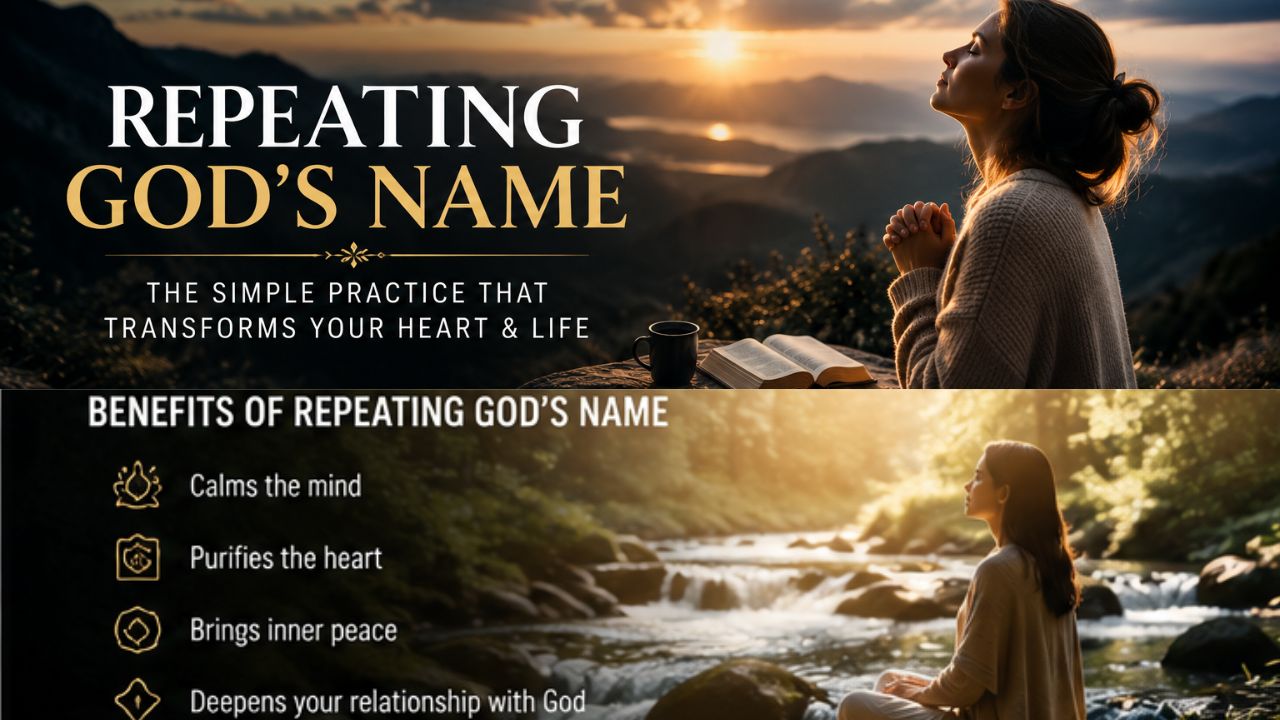
There is a moment — quiet, unhurried — when a single name rises from the depths of your heart and changes everything.
Across every major spiritual tradition on earth, from the banks of the Ganges to the hills of Jerusalem, from the desert monasteries of Egypt to the prayer halls of Mecca, one practice has endured for thousands of years: repeating God’s name every day.
It sounds almost too simple. Say a name. Say it again. Keep saying it. Yet saints, sages, mystics, and now scientists are all pointing to the same conclusion: this ancient practice quietly transforms the mind, soothes the nervous system, and opens something deep in the human heart.

So what are the real benefits of repeating God’s name — and what can you expect when you make it a daily habit? This article covers everything: the spiritual wisdom, the scientific evidence, which name to choose, and exactly how to begin.
What Does “Repeating God’s Name” Mean Across Traditions?
Before diving into the benefits, it helps to understand that the benefits of repeating God’s name have been recognized across virtually every major religion. This is not the exclusive property of any one tradition. It is a universal spiritual technology.
- Hinduism calls it Naam Japa — the repetition of divine names like Ram, Om Namah Shivaya, or Hare Krishna. The Naam Japa benefits are so highly regarded that saints like Tukaram and Mirabai built their entire spiritual lives around this practice.
- Islam calls it Dhikr (divine remembrance). Dhikr benefits are described extensively in the Quran and Hadith — practitioners repeat names like Allah, Subhanallah, or La ilaha illallah, often using prayer beads called tasbih.
- Christianity uses the Jesus Prayer — “Lord Jesus Christ, Son of God, have mercy on me” — a practice central to Eastern Orthodox spirituality. The Jesus Prayer benefits have been written about since at least the 5th century CE.
- Sikhism places Naam Simran (remembrance of the divine name) at the very heart of spiritual life. Naam Simran benefits include inner peace, purification, and union with the divine, as described in the Guru Granth Sahib.
- Buddhism uses mantra repetition such as Om Mani Padme Hum, treating sacred sound as a path to liberation and compassion.
The details differ. The spirit is the same: when you repeat a sacred name with sincerity, you are aligning your inner world with the divine.
9 Powerful Benefits of Repeating God’s Name Daily
1. Your Mind Becomes Calmer and More Focused
The human mind is famously restless. Ancient yogic texts describe it as a monkey mind — swinging from thought to thought, worry to worry. Repeating God’s name gives the mind something sacred to hold onto.
With consistent daily spiritual practice, practitioners across traditions report a gradual quieting of mental noise. The name acts like an anchor. When anxious thoughts arise, the name calls the mind back. When grief floods in, the name offers a shore to stand on.
Over weeks and months of repeating God’s name daily, many practitioners notice their mind begins to default to the name rather than to worry — and through the name, to a felt sense of peace that was always there beneath the noise.
2. Stress Levels Drop Measurably
When you sit and repeat God’s name with gentle focus, your body shifts into a state of deep rest. Many practitioners describe the nervous system responding as though it has received a quiet signal: It is safe to relax now.
The chronic low-grade tension that many people carry — in the jaw, the shoulders, the chest — begins to dissolve. This isn’t coincidence, and it isn’t wishful thinking. The science explains exactly why (see the dedicated science section below).
3. Anxiety Loses Its Grip
Anxious minds tend to spiral. One worried thought leads to another until a small concern feels catastrophic. Prayer repetition interrupts this spiral by giving the mind a different track to run on.
Many long-term practitioners report that after months of repeating God’s name daily, anxiety no longer has the same power over them. It arises — but it passes more quickly. They have, essentially, built a refuge in the name that the mind returns to automatically when stress threatens to take over.
4. You Build a Real, Living Relationship with the Divine
Prayer repetition is often misunderstood as mechanical or mindless. But experienced practitioners describe something far more alive. Each repetition is a tiny act of reaching out. Each one says: I remember You. I choose You. I am here.
Over time, this builds what mystics of every tradition describe as intimacy with the sacred. God stops feeling like an abstract theological concept and begins to feel like a living presence — a companion in the ordinary moments of life.
The 13th-century Sufi poet Rumi didn’t write philosophical treatises. He wrote love poetry — because for him, Dhikr had made the divine as immediate and personal as a beloved.
5. Spiritual Purification: You Become Lighter Inside
Most traditions teach that the heart accumulates impressions — samskaras in Sanskrit, sins in Abrahamic language — that cloud our perception of reality and ourselves. Repeating God’s name is understood as a gentle, persistent inner cleansing.
Think of it like water on stone. One drop doesn’t carve the canyon. But water, flowing faithfully every day for a thousand years, shapes mountains. Each repetition is one drop. A lifelong practice is the river.
Many long-term practitioners describe becoming gradually lighter — less reactive, less burdened by old grievances, more able to forgive and to love.
6. Greater Emotional Resilience in Difficult Times
People who maintain a daily spiritual practice of name repetition often describe a quality that is hard to pin down precisely: a kind of inner steadiness. Life continues to bring its difficulties — loss, disappointment, uncertainty — but there is something underneath that doesn’t shake.
This is what the Psalms of David describe. This is what Guru Nanak wrote about. This is what Christian hesychasts called apatheia — not coldness or emotional numbing, but an unshakeable inner peace that remains even in the storm.
7. Compassion Expands Naturally
Perhaps the most practically transformative benefit that practitioners across traditions report is a natural reduction in self-preoccupation — and a corresponding expansion of compassion and care for others.
When the mind is less caught in its own dramas, there is simply more room for other people. This is not a side effect of the practice. In most traditions, it is the point. The spiritual benefits of chanting God’s name ultimately flow outward — into relationships, into service, into a more generous way of moving through the world.
8. Profound States of Inner Peace
Many practitioners, after months or years of consistent sacred name meditation, report experiences of profound stillness — moments where the ordinary sense of separation between self and the divine dissolves temporarily. Traditions across the world have given these moments different names: samadhi, fana, theosis, satori.
These experiences are not the goal (seeking peak experiences can actually become its own distraction), but they are reported frequently enough across traditions to be considered a natural fruit of sincere, sustained practice.
9. The Name Eventually Prays Itself
One of the most remarkable reports from long-term practitioners is that the name eventually begins to repeat itself — spontaneously, without effort. Indian saints call this Ajapa Japa, the prayer that prays itself. The name becomes so deeply embedded in awareness that it runs in the background of daily life, like a quiet river beneath the noise of the world.
This is not supernatural. It is simply what happens when any habit becomes deeply integrated: it moves from effortful practice to effortless presence. The name becomes the default state of the mind rather than a scheduled activity.
What Science Says About Repeating God’s Name
The science of mantra repetition and spiritual chanting has grown significantly in recent decades, and the findings consistently support what practitioners have experienced for millennia.
The Brain Under Sacred Repetition
Neuroimaging studies on meditation and mantra practices show that repetitive, focused prayer activates the prefrontal cortex — the brain region associated with attention, emotional regulation, and decision-making — while quieting the default mode network, which is responsible for mind-wandering, rumination, and self-referential thinking (the “mental chatter” that drives anxiety and stress).
In simpler terms: repeating God’s name trains your brain to be present rather than lost in worry.
Cortisol and the Stress Response
Multiple peer-reviewed studies on mantra meditation report measurable reductions in cortisol, the body’s primary stress hormone. Lower cortisol levels are associated with better sleep, reduced inflammation, improved immune function, and lower risk of stress-related illness.
A 2011 study published in the International Journal of Yoga found that regular mantra repetition produced significant reductions in perceived stress and anxiety in participants after just eight weeks of practice. Practitioners of Naam Simran and similar traditions have been reporting this for centuries — science is now offering the biological explanation.
Parasympathetic Activation
When you repeat God’s name with gentle, rhythmic focus, your breathing naturally slows and deepens. This shift activates the parasympathetic nervous system — sometimes called the “rest and digest” system — counteracting the chronic “fight or flight” state that many people live in without realizing it.
Heart rate variability (HRV), a key marker of cardiovascular health and emotional resilience, improves with regular meditative practices that include breath-coordinated repetition. Many Dhikr traditions and the Rosary specifically combine name repetition with rhythmic breathing, intuitively harnessing this physiological benefit.
Anxiety and Depression Research
A growing body of research on mantra-based meditation shows reductions in anxiety and depressive symptoms in both clinical and non-clinical populations. While this is not a replacement for professional mental health care, it suggests that the benefits of repeating God’s name extend meaningfully into psychological wellbeing — not just spiritual experience.
Important note: If you are experiencing severe anxiety or depression, please work with a qualified healthcare professional. Spiritual practice is a powerful complement to proper care — not a substitute for it.
Which Name of God Should You Repeat?
This is one of the most common questions for those new to the practice — and one of the most important to answer well.
Follow Your Tradition First
If you belong to a faith tradition, begin with the sacred names or prayers of that tradition. This is almost always the wisest starting point, because a name or phrase that carries the weight of your personal faith, your community’s prayers, and centuries of practice carries far more resonance than one chosen at random.
Here are the most widely used and spiritually potent names across traditions:
For Naam Japa (Hindu tradition):
- Ram — Considered by many saints, including Gandhi, to be the most complete single-syllable name of God
- Om Namah Shivaya — One of the most widely practiced five-syllable mantras
- Hare Krishna (the Maha Mantra) — Sixteen names arranged for maximum resonance
- Om alone — The primordial sound in yogic tradition
For Dhikr (Islamic tradition):
- Allah — The essential divine name
- Subhanallah (Glory be to God)
- Alhamdulillah (All praise is for God)
- La ilaha illallah (There is no god but God) — The foundational declaration of Islamic faith
For Christian practice:
- Jesus alone — Simple, ancient, and deeply powerful
- The Jesus Prayer: “Lord Jesus Christ, Son of God, have mercy on me, a sinner” — The complete hesychast practice
- Maranatha — An ancient Aramaic prayer meaning “Come, Lord” — recommended by Christian contemplatives like Thomas Merton and John Main
For Naam Simran (Sikh tradition):
- Waheguru — The primary divine name in Sikhism, meaning “Wondrous Enlightener”
- Sat Nam — “Truth is God’s name”
For Buddhist practice:
- Om Mani Padme Hum — The mantra of Avalokiteshvara, the bodhisattva of compassion
- Namo Amituofo (Pure Land Buddhism) — Recitation of Amitabha Buddha’s name
How to Choose If You Are Spiritually Eclectic
If you don’t belong to a specific tradition, choose a name or phrase that genuinely moves you — that stirs something real in your heart, not just your intellect. Avoid choosing a name simply because it sounds exotic or because someone famous uses it.
The power of repeating God’s name does not lie in the syllables themselves so much as in the sincerity and consistency you bring to them. A simple “God” or “Lord” repeated with genuine longing is worth far more than an elaborately chosen Sanskrit mantra repeated with wandering attention.
The One Name That Works Best for Beginners
For absolute beginners, teachers across many traditions recommend starting with a short, simple name — ideally one or two syllables — from the tradition closest to your heart. Ram, Jesus, Allah, Waheguru: short enough to coordinate with a single breath, sacred enough to carry real weight. Begin there. You can always expand your practice later.
How to Begin Your Daily Practice
Creating a Simple Daily Routine
You don’t need to become a monk to experience the benefits of repeating God’s name. Begin modestly and build consistency.
Step 1 — Choose a time. Morning is ideal for most people, before the day’s demands crowd in. Even 10 minutes is a meaningful start. Consistency matters far more than duration.
Step 2 — Find a quiet spot. Sit comfortably with your spine upright. You don’t need a special cushion or altar, though these can help signal to your mind that something different is about to happen.
Step 3 — Begin repeating. Say the name silently or softly aloud. Let your breath slow naturally. Some traditions coordinate the name with the breath — inhaling on one syllable, exhaling on another. Others simply let the name flow at its own pace.
Step 4 — When the mind wanders, return. This is the entire practice. Not staying focused perfectly, but returning — again and again — without judgment. Every return is a small act of devotion.
Step 5 — Close gently. Spend a moment in silence after the formal repetition ends. Let the resonance settle before moving into your day.
Using Prayer Beads for Counting
Many traditions use beads to track repetitions — the Hindu mala (108 beads), the Islamic tasbih (33 or 99 beads), the Christian rosary (59 beads). These serve a dual purpose: they give the hands something to do (which deepens focus), and they help maintain consistency across sessions.
Common Mistakes to Avoid
Treating it as a performance. Repetition of God’s name is not for God’s benefit. It is for yours. Approach it as sincere reaching-out, not religious obligation to discharge.
Expecting instant results. Some people feel calmer after their first session. Others feel nothing for weeks. This is normal. The benefits of repeating God’s name accumulate gradually — often in ways you don’t fully notice until you look back months later.
Being harsh with yourself when your mind wanders. Mind-wandering is not failure. It is the practice. Each time you notice and return, you are exercising the muscle.
Stopping too soon. Give the practice at least 40 days of consistent daily effort before drawing conclusions. Most traditions consider 40 days a meaningful threshold. Three months is even better.

Frequently Asked Questions
Q: What are the main benefits of repeating God’s name every day?
A: The most consistently reported benefits include reduced stress and anxiety, greater emotional stability, a deepening sense of divine presence, improved mental focus, and — over time — a natural expansion of compassion and inner peace. Science points to measurable reductions in cortisol and activation of the parasympathetic nervous system as partial explanations.
Q: Which name of God is most powerful for beginners?
A: The most powerful name is almost always the one from the tradition you genuinely belong to, repeated with sincere attention. For Hindu practitioners, Ram is widely considered the most accessible starting point. For Christians, Jesus or the Jesus Prayer. For Muslims, Allah or Subhanallah. For Sikhs, Waheguru. Simplicity and sincerity outweigh elaborateness every time.
Q: How many times should I repeat God’s name in a session?
A: Traditions vary. Common recommendations range from 108 repetitions (one mala) to 100 in Islamic Dhikr practice (33+33+34). For beginners, focusing on time — 10 to 20 minutes — is often easier than counting. The quality of attention matters more than the quantity of repetitions.
Q: Do I have to belong to a religion to practice this?
A: No. While this practice is rooted in religious traditions, many people engage with it in an open, non-sectarian way. Sincere intention and consistent practice are the essential requirements. That said, practicing within a living tradition often provides depth, guidance, and community that enriches the experience considerably.
Q: What if I feel nothing when I repeat the name?
A: Very common, especially early on. Dryness or lack of feeling doesn’t mean the practice isn’t working. In many traditions, continuing faithfully through “dry” periods is considered especially valuable — it demonstrates that the practice is rooted in sincerity rather than the pursuit of pleasant experiences. Keep going.
Conclusion: Begin Today — 7 Days That Could Change Everything
The benefits of repeating God’s name are available to anyone — regardless of religious background, spiritual experience, or available time. This practice costs nothing, requires nothing special, and asks only for sincerity and a few minutes each day.
What it offers in return has been documented across the lives of saints and sages for thousands of years, and increasingly confirmed by modern science: a quieter mind, a steadier heart, a real and growing sense of divine presence, and — over time — a life shaped not by fear or distraction but by genuine inner peace.
Here is a simple invitation: For the next 7 days, spend just 10 minutes each morning repeating God’s name. Notice what shifts in your thoughts, your emotional reactions, the quality of your attention, and your sense of being accompanied through the day.
You don’t have to commit to a lifetime. Just begin with seven days. The river starts with a single drop — and you can choose to let that drop fall today.
4th of July Prayer

Role: Founder & Spiritual Writer at TheGodMessage.com
About: Himanshu is a Jesus-centered writer known for creating clear, uplifting, and Bible-rooted content for modern believers.
Expertise: specializes in prayers, devotionals, and spiritual guidance designed to help readers grow stronger in faith no matter where they are in life.
Purpose: His mission is to inspire readers to connect with their inner self, experience peace, and understand the messages of the universe. “My mission is simple, to bring God’s light into your everyday life.”