

Some prayers are born out of desperation. This one was.
There are moments in life when you close the door to your room, sit on the edge of your bed, and feel something you can’t quite name. Not sadness exactly. Not fear exactly. Just the weight of it all — the noise of the world pressing in, the feeling that something is deeply wrong, that forces bigger than you are moving around you.
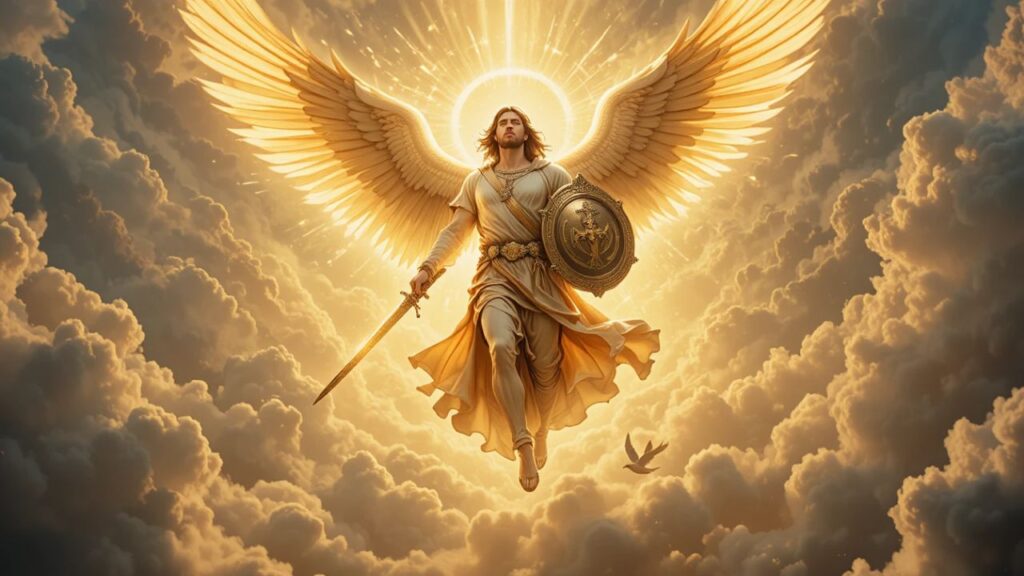
In those moments, many people reach for the same ancient words.
“Saint Michael the Archangel, defend us in battle…”
Prayer to St. Michael the Archangel is not just a prayer. For millions of Catholics around the world, it is a cry from the soul — words spoken in foxholes, in hospital waiting rooms, in the dark hours before dawn when sleep won’t come. It is a prayer that has survived centuries because it meets people exactly where they are: in the middle of the fight.
The Story Behind the Prayer
The year was 1884. Pope Leo XIII had just finished celebrating Mass in the Vatican. According to accounts passed down through generations, he suddenly stopped — pale, motionless — as if frozen in a vision. When he recovered, he was shaken. He described a terrifying exchange he had witnessed: the voice of Satan demanding time and power to test the Church, and God granting it.
Whether or not you take the account as literal, what matters is what Pope Leo XIII did next. He composed a prayer. A specific, urgent prayer — calling on Michael the Archangel, the great warrior of heaven, to defend the faithful against evil.
He ordered it prayed at the end of every Low Mass. For nearly 80 years, Catholics around the world ended their liturgy with those words, generation after generation, in Latin, in English, in dozens of languages — the same plea rising from millions of lips.
Defend us. We are in battle. We need help.
Who Is St. Michael, Really?
Before you can understand why this prayer still moves people, you need to understand who Michael is — not as a distant theological concept, but as a presence that countless believers have experienced as real and close.
Michael is mentioned in the Old Testament, in the New Testament, in the Quran. He appears in Jewish, Christian, and Islamic tradition alike. He is the warrior angel — the one whose very name is a question and an answer: Mi-cha-el means “Who is like God?” The answer, of course, is no one. It is a battle cry dressed up as a name.
In the Book of Revelation, it is Michael who leads the armies of heaven against the dragon. In the Book of Daniel, he is the great prince who stands guard over God’s people. In tradition, he is the angel of death who escorts souls, the one who weighed in at the scales of justice, the leader of heaven’s armies.
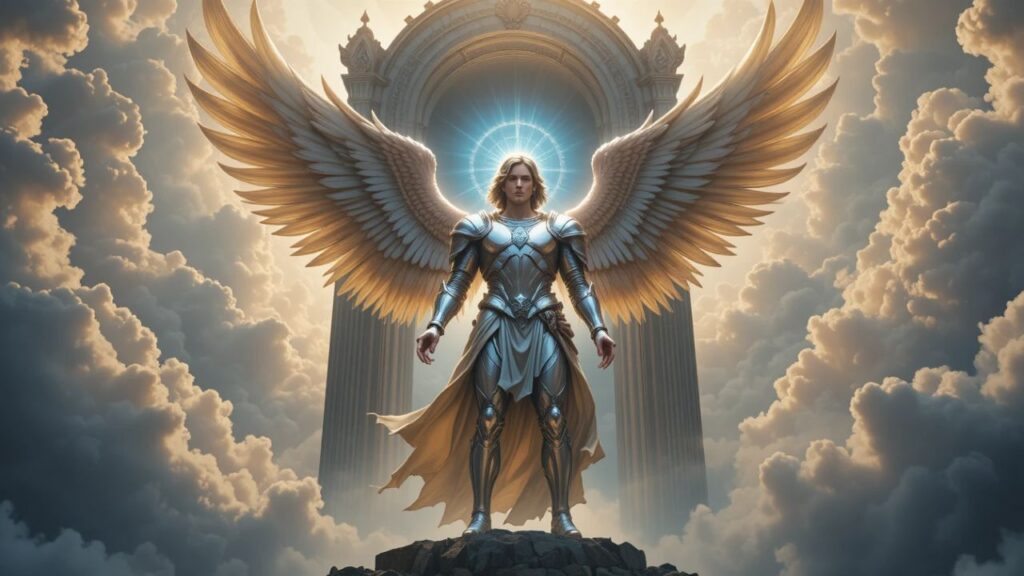
He is not a soft, cherubic figure with tiny wings. He is depicted with a sword, with armor, with his foot pressed on the neck of a fallen enemy.
He is, in the imagination of the faithful, someone you’d want on your side.
Revelation 12:7-9
“Then war broke out in heaven. Michael and his angels fought against the dragon…”
The Words Themselves
The full prayer, as most Catholics know it, is not long. But read it slowly — really slowly — and notice how every line carries weight:
Saint Michael the Archangel, defend us in battle.
That first line alone is remarkable in its honesty. It doesn’t begin with praise or petition for blessings. It begins with an acknowledgment: we are at war. Not with other people. With something darker. Something the prayer names directly.
Be our protection against the wickedness and snares of the devil.
“Snares.” That word. A snare is not a frontal attack — it’s a trap you don’t see until you’re already in it. The prayer recognizes that many of the battles we face are hidden ones: the slow erosion of hope, the creeping cynicism, the whispers that tell you you’re not enough, not loved, not worth fighting for.
May God rebuke him, we humbly pray.
And here is the humility at the center of it all. Even in asking Michael for protection, the prayer bows before God. It is not Michael who has the ultimate power. It is always God. Michael is the instrument. The prayer is an act of surrender as much as a battle cry.
And do thou, O Prince of the Heavenly Host, by the power of God, thrust into hell Satan and all evil spirits who wander through the world seeking the ruin of souls.
“The ruin of souls.” Not just inconvenience. Not just suffering. The ruin of something precious, something irreplaceable. The prayer is not asking for a comfortable life. It’s asking for the survival of the deepest part of what you are.
The Full Prayer to St. Michael the Archangel
Saint Michael the Archangel,
defend us in battle.
Be our protection against the wickedness and snares of the devil.
May God rebuke him, we humbly pray;
and do thou, O Prince of the Heavenly Host,
by the power of God,
thrust into hell Satan and all evil spirits
who prowl about the world
seeking the ruin of souls.
Amen.
Why People Still Pray It
In an age of smartphones and psychology and self-help books, why does a 19th-century prayer composed by a pope after a vision still move people to tears?
Because it tells the truth.
There is something broken in the world. You feel it. Most people feel it. The prayer doesn’t ask you to pretend otherwise or to positive-think your way past the darkness. It says: yes, there is a battle. And you don’t have to fight it alone.
A mother prays it over her child who has fallen into addiction. A soldier prays it quietly before a mission. A woman leaving an abusive relationship whispers it in her car, hands shaking on the steering wheel. A teenager sitting alone in his room at 2am prays it when the darkness in his own mind feels like it’s winning.
The prayer doesn’t promise that everything will be easy. It promises presence. It promises that the warrior of heaven is standing between you and whatever is coming for you.
That is enough. Often, it is more than enough.
Praying It With Your Whole Self
There is a difference between reciting a prayer and praying it. The words are the same. But one is a habit and the other is an encounter.
If you want to pray the Prayer to St. Michael and actually feel it land — try this:
Before you begin, breathe. Bring to mind whatever you are fighting right now. The anxiety you woke up with. The relationship that’s fraying at the edges. The fear you’ve been carrying alone for months. The thing you haven’t told anyone.
Hold that in your hands, so to speak. And then begin.
Saint Michael the Archangel, defend us in battle.
Let the word “us” mean something. You are not alone in this. Every person who has ever felt overwhelmed, every person who has prayed these words in desperation — you are with them somehow, across time and geography, in a communion of people who needed help.
Be our protection against the wickedness and snares of the devil.
Name the snares specifically, in your own heart. The lies you’ve believed. The traps you’ve fallen into. The habits that have been quietly ruining you.
And then let the rest of the prayer do what it was written to do: hand the battle to someone bigger.
A Final Word
You may not be Catholic. You may not be sure what you believe. You may have grown up religious and drifted, or never had faith at all, and yet found yourself reading this far because something in the phrase “defend us in battle” rang true.
That’s the remarkable thing about this prayer. Its power doesn’t come from a theological system. It comes from a human truth: we are fragile. We are fighting things we can’t always see. And we desperately want to know that something good is stronger than what we’re up against.
St. Michael the Archangel was not invented to make people feel better. He was, in the tradition, appointed to a specific task: to stand between the darkness and the beloved. To say, with sword raised: Not today. Not this one. Not on my watch.
Psalm 91:11
“For He will command His angels concerning you to guard you in all your ways.”
When you pray this prayer, you are not performing a ritual. You are calling on a name that has been called across centuries by people who were scared, and exhausted, and still, somehow, not without hope.
That is what prayer is for.
And if tonight you close your door, sit on the edge of your bed, and feel the weight of everything pressing in — know that these words are waiting for you, just as they waited for everyone who came before.
Saint Michael the Archangel, defend us in battle.
Say them like you mean them. Someone, tradition promises, is listening.
“Who is like God?” No one. And that is exactly the point.
4th Of July Prayer
