
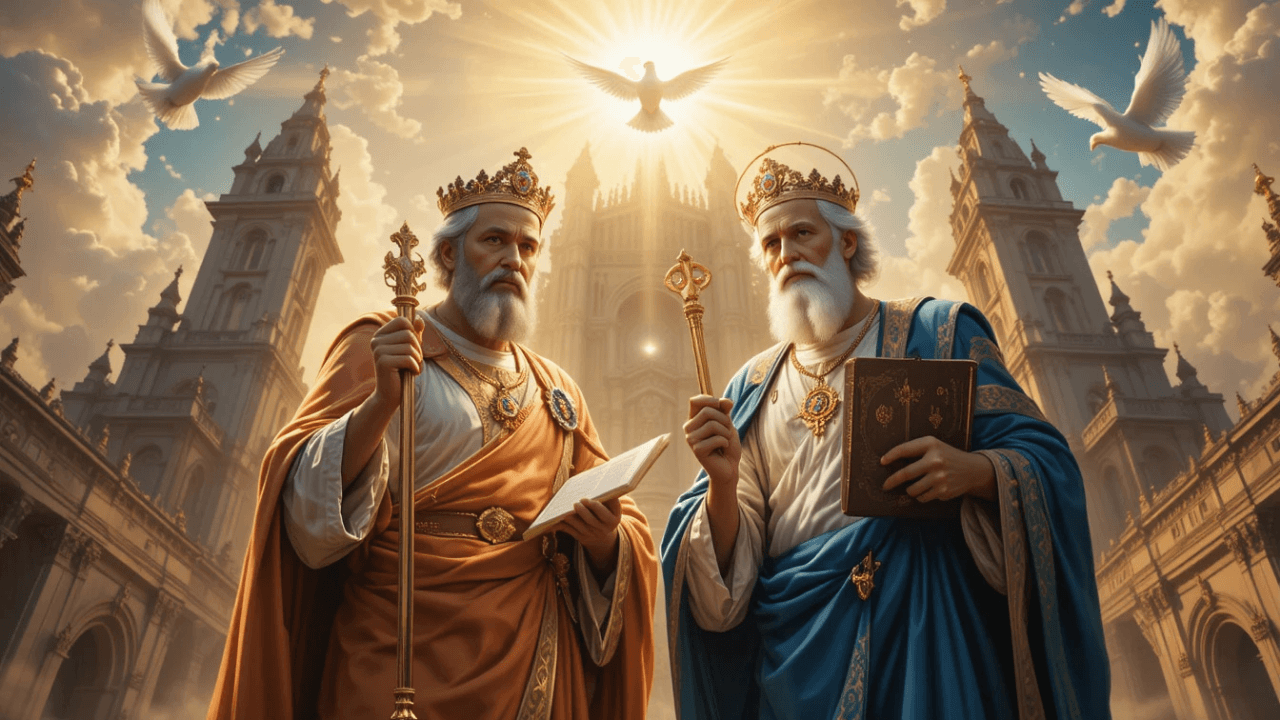
Two Pillars, One Feast, One Faith
There is something quietly magnificent about a single day honoring two men who could not have been more different — yet whose lives, deaths, and legacies became the twin pillars of the Christian Church.
Peter, the fisherman. Impulsive, passionate, a man who once denied the Lord three times in a courtyard lit by firelight. Paul, the Pharisee. A persecutor of Christians who was knocked to the ground by a blinding light on the road to Damascus and rose up utterly changed.
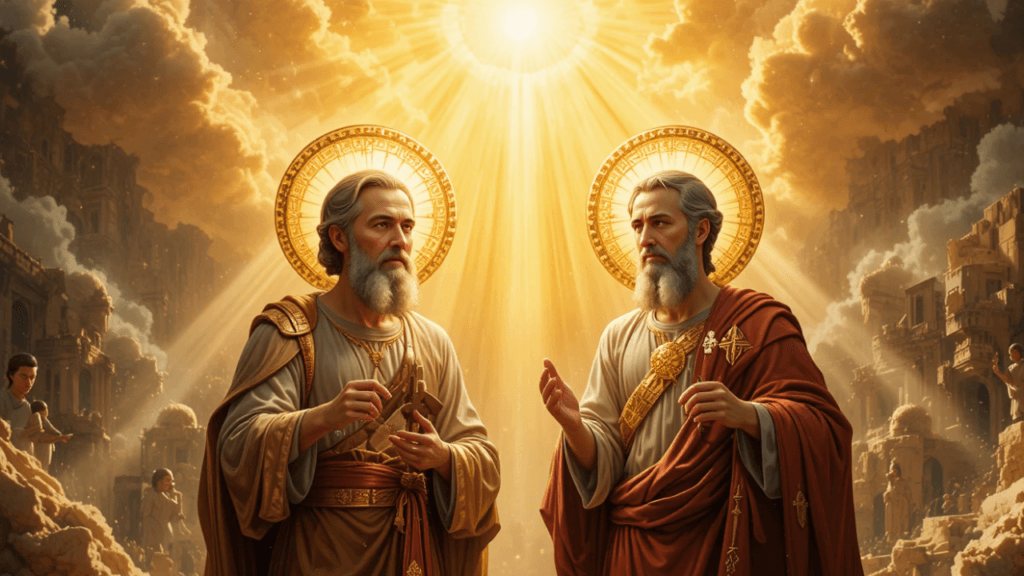
On June 29 every year, the Catholic Church, Eastern Orthodox communities, and many other Christian traditions come together to celebrate the Feast of Saints Peter and Paul — a day soaked in prayer, Scripture, reflection, and joy.
Whether you are looking for the right Saints Peter and Paul prayer, searching for Bible verses that capture their spirit, or simply want to understand the deeper meaning of this feast day, this guide is written for you. Come with an open heart. This feast has a way of meeting people exactly where they are.
What Is the Feast of Saints Peter and Paul? (And Why Does It Matter?)
Direct Answer: The Feast of Saints Peter and Paul is celebrated on June 29 each year. It honors two of the most important apostles in Christian history — Saint Peter, considered the first Pope and the “rock” upon which Christ built His Church, and Saint Paul, the great missionary whose letters make up a significant portion of the New Testament.
This is not simply a historical commemoration. It is a living feast, celebrated with Mass, prayer, community gatherings, and deep personal reflection across the globe — from Rome to Manila, from Lagos to Lima.
Why June 29?
The date June 29 has been observed since at least the 3rd century. Church tradition holds that both Peter and Paul were martyred in Rome under Emperor Nero around 64–68 AD, and that June 29 marks the anniversary of either their deaths or the transfer of their relics. What matters most is not the precise historical date but what the day represents: the courage to believe, the cost of faith, and the power of transformation.
A Feast for the Whole Church
In Catholic tradition, this is a solemnity — the highest rank of feast day. In some countries, it remains a public holiday. In Rome, the Pope traditionally celebrates Mass at St. Peter’s Basilica, and the faithful from around the world gather in St. Peter’s Square, a moment that feels like the whole Church breathing in unison.
The Story Behind the Saints: Two Lives That Changed the World
Saint Peter: The Rock Who Once Cracked
Born Simon, a fisherman from Galilee, Peter was renamed by Jesus himself: “You are Peter, and on this rock I will build my Church” (Matthew 16:18). That name — Petros, meaning rock — carried both a promise and a weight.
Peter was the first to confess Jesus as the Christ. He was there at the Transfiguration. He walked on water — briefly, until fear pulled him under. He promised he would never abandon Jesus, and then denied Him three times before the rooster crowed.
And yet.
After the Resurrection, Jesus found Peter by the sea and asked him, three times: “Do you love me?” Three denials met with three chances to begin again. Peter wept with grief. He was given back his mission. And he carried it, all the way to Rome, all the way to a cross — tradition holds he was crucified upside down, refusing to die in the same manner as his Lord.
That is the arc of Peter’s life: ordinary man, broken man, restored man, saint.
Saint Paul: The Enemy Who Became the Greatest Champion
Saul of Tarsus was educated, zealous, and deeply convinced that the followers of Jesus were a dangerous heresy. He held the coats of those who stoned Stephen, the first Christian martyr. He obtained letters to arrest Christians in Damascus.
Then the road happened.
A light. A voice: “Saul, Saul, why do you persecute me?” (Acts 9:4). Blinded, led into the city, fasting three days — and then a new life began. Paul would travel thousands of miles across the Roman Empire, planting churches, enduring shipwrecks, imprisonment, beatings, and finally execution in Rome. He wrote letters — to the Romans, the Corinthians, the Galatians — that people still read, weep over, and live by today.
“I have learned, in whatever state I am, to be content,” he wrote from prison (Philippians 4:11). That is not the philosophy of a man defeated. That is a man who found something that could not be taken away.
Saints Peter and Paul Bible Verses: Words That Endure
Scripture is the heartbeat of this feast. These verses speak directly to the lives, mission, and message of Peter and Paul — and they speak just as powerfully to our own lives today.
Words of Saint Peter
Matthew 16:16 — “You are the Christ, the Son of the living God.” This was Peter’s moment of recognition — the confession that named everything. Whatever confusion or doubt had gathered in his heart before, in this moment, he saw clearly.
John 21:17 — “Lord, you know everything; you know that I love you.” After the betrayal, after the grief, Peter’s restoration was not built on achievements or explanations. It was built on love, stated plainly and with a whole heart.
1 Peter 5:7 — “Cast all your anxiety on him because he cares for you.” Peter knew anxiety. He knew the weight of failure and fear. This verse, written late in his life, is not a platitude — it is the hard-won testimony of a man who had learned to let go.
Words of Saint Paul
Romans 8:38-39 — “For I am convinced that neither death nor life, neither angels nor demons, neither the present nor the future, nor any powers, neither height nor depth, nor anything else in all creation, will be able to separate us from the love of God that is in Christ Jesus our Lord.” This is Paul at his most luminous — absolute, unshakeable certainty voiced from the middle of suffering.
Philippians 4:13 — “I can do all this through him who gives me strength.” Often quoted, sometimes misapplied — but in Paul’s original context, it is about enduring hardship with grace, not achieving worldly ambitions.
2 Timothy 4:7 — “I have fought the good fight, I have finished the race, I have kept the faith.” Written near the end of Paul’s life, believed to be just before his execution. These are the words of a man at peace. A man who ran his full race.
Saints Peter and Paul Prayers: Speak to Them Today
Prayer on this feast day carries a particular quality — the sense that you are not speaking into silence, but into a room where two great witnesses are listening. Here are prayers you can carry with you through June 29 and beyond.
Prayer to Saint Peter
O Saint Peter, Prince of the Apostles, you who were chosen by Christ to be the rock on which He built His Church — pray for us in our weakness. When we deny what we know to be true, when fear wins a moment it should not have won, remind us that we are not finished. That mercy runs deeper than any failure. That love, asked three times, can always say yes again. Pray for the Church you served with your life. Pray for all who lead and all who follow. And pray for us who are still, in so many ways, learning what it means to love. Amen.
Prayer to Saint Paul
O Saint Paul, Apostle to the Nations, you who were stopped on your own road and given a new one — intercede for us when we are blind to what we are doing, when our certainties have hardened into walls. You learned contentment in prison. You found peace in shipwreck. Teach us your secret. Help us fight the good fight, not with noise but with conviction. Help us finish the race given to us, not someone else’s. And when our work is done, may we say with you: I have kept the faith. Amen.
A Family Prayer for the Feast of Saints Peter and Paul
Lord God, on this feast day of Saints Peter and Paul, we gather as a family to give thanks for two men who gave everything. Bless us with Peter’s courage to begin again after we fall. Bless us with Paul’s fire to carry the gospel into every corner of our lives. May their witness inspire our own. May this feast day be more than a date on a calendar — may it be a moment when faith becomes a little more alive in us. Amen.
Saints Peter and Paul Blessings: Words to Carry Into the Day
Blessings on this feast day are traditionally offered at Mass, in homes, and within communities. Here are some you can offer to the people you love:
A blessing for a friend: “May the faith of Peter steady you in every storm, and the zeal of Paul carry you forward into every new beginning. Blessed feast day.”
A blessing for a family: “May your home be built on rock, not sand. May your lives be letters written in love — read by all who know you. God bless you on this feast of Saints Peter and Paul.”
A blessing for someone going through difficulty: “Like Peter, may you find that grace comes after the fall. Like Paul, may you discover strength in the very place you feel weakest. You are held. You are not alone.”
A blessing for a leader or pastor: “May the mantle of Peter rest lightly and firmly on your shoulders today — the weight of responsibility carried with the lightness of love. You are prayed for.”
How to Celebrate the Feast of Saints Peter and Paul in 2026
This feast falls on Monday, June 29, 2026. Here are meaningful ways to mark the day, whether you are celebrating alone, with family, or with your parish community.
Attend Mass or a special service. Many parishes hold special Masses on this solemnity. If your local church offers one, make the effort to attend — there is something different about celebrating liturgy alongside others on a feast day.
Read the Acts of the Apostles. Chapters 1–5 for the story of Peter; chapters 9 and 13–28 for Paul’s missionary journeys. Even a single chapter can anchor the feast day in something real and textured.
Pray one of the prayers above. Alone, with your family, before breakfast. Prayer does not need to be long to be honest.
Share a blessing with someone. Send a text. Write a card. Tell someone that on this day, you prayed for them and thought of two men who gave everything so the faith could reach you.
Light a candle. A simple act that carries enormous symbolic weight. Two candles, if you like — one for Peter, one for Paul.
Have a special meal with your community. In many cultures, June 29 is a day of feasting and gathering. There is nothing wrong with celebrating with food and laughter — the apostles ate together too.
FAQ: Common Questions About the Feast of Saints Peter and Paul
Q: Is the Feast of Saints Peter and Paul a holy day of obligation?
In many countries, yes — Catholics are required to attend Mass. However, in some countries (including the United States), the obligation is dispensed when the feast falls on a Saturday or Monday. Check with your local diocese for guidance.
Q: Why are Peter and Paul celebrated together on the same day?
Church tradition has always linked them as the two great founders of the Church of Rome. Though they were very different in personality and background, their martyrdom in Rome and their shared mission to spread the Gospel made them inseparable in memory and devotion.
Q: What is the color for the Feast of Saints Peter and Paul?
Red — the liturgical color for martyrs and the Holy Spirit. Both Peter and Paul gave their lives for the faith, making red the fitting choice.
Q: Can I pray to Saint Peter and Saint Paul for specific intentions?
Absolutely. Saint Peter is traditionally invoked for protection, leadership, the papacy, and for those who have failed and need restoration. Saint Paul is invoked for missionaries, writers, theologians, people undergoing conversion, and those facing trials or persecution.
Q: What is the significance of the keys in images of Saint Peter?
The keys — often depicted as gold and silver — represent the authority given to Peter by Jesus: “I will give you the keys of the kingdom of heaven” (Matthew 16:19). They symbolize the power to bind and loose, to open and close, entrusted to the Church through Peter’s leadership.
Conclusion: Two Broken, Beautiful Lives — and What They Say to Yours
There is a reason these two men have been remembered and prayed to for nearly two thousand years. It is not because they were perfect. It is precisely because they were not.
Peter was afraid. Peter denied the person he loved most. And Peter became the rock.
Paul was wrong — catastrophically, violently wrong — and on a dusty road outside Damascus, he was given a second chance he had not asked for and did not deserve. And he became the greatest missionary the world has ever seen.
What does that say to you, reading this on an ordinary day in 2026?
It says: your failures are not the final word. Your past is not a wall. The same love that restored Peter’s courage and redirected Paul’s fire is not a thing of the ancient world. It is present tense. It is available now.
On June 29, light a candle. Speak a prayer. Read a verse. Offer a blessing to someone who needs it. And let this feast remind you that the story is not over — for the Church, or for you.
“I have fought the good fight. I have finished the race. I have kept the faith.” May we all say the same, when our time comes.
Looking for more feast day prayers, reflections, and Catholic resources? Explore prayers for the liturgical calendar, saints’ intercessions, and family blessings throughout the year.
Related Article:
Sacred heart novena

Role: Founder & Spiritual Writer at TheGodMessage.com
About: Himanshu is a Jesus-centered writer known for creating clear, uplifting, and Bible-rooted content for modern believers.
Expertise: specializes in prayers, devotionals, and spiritual guidance designed to help readers grow stronger in faith no matter where they are in life.
Purpose: His mission is to inspire readers to connect with their inner self, experience peace, and understand the messages of the universe. “My mission is simple, to bring God’s light into your everyday life.”