
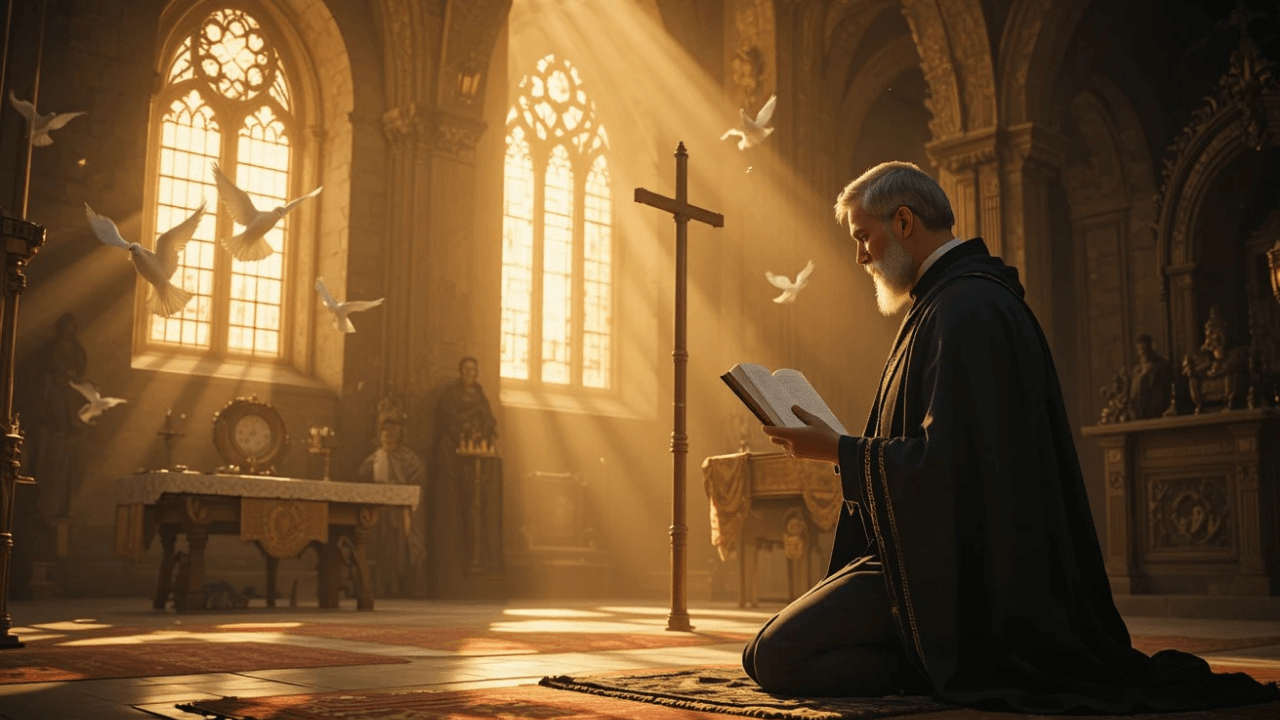
If you’ve ever felt like you needed an extra layer of spiritual armor — something to steady you when anxiety, temptation, or unexplainable heaviness creeps into your home or your heart — you’re not alone. For over a thousand years, Catholics and Christians of many traditions have turned to one particular prayer for exactly that reason: the St. Benedict prayer.

This isn’t a trendy new devotion. It’s one of the oldest and most trusted prayers in Christian history, tied to a small medal that millions of people carry, wear, or hang in their homes to this day. In this guide, you’ll learn who St. Benedict was, why his prayer is considered so powerful against evil, the full text of the prayer in English, and practical ways to use it — whether you’re blessing your home, starting a novena, or simply looking for a daily prayer of protection.
Who Was St. Benedict?
St. Benedict of Nursia was born around 480 A.D. in the Italian town of Nursia. He’s widely regarded as the father of Western monasticism, and his famous “Rule of St. Benedict” — a guidebook for monastic life built on balance, prayer, work, and community — shaped Christian religious life for centuries and still guides monasteries today.
Benedict wasn’t just a scholar or an administrator. Tradition holds that he faced repeated attempts on his life, including poisoned bread and wine, and that he overcame these dangers through prayer and the sign of the cross. This history is a big part of why his name became so closely associated with protection from evil, poison, and spiritual attack.
He died around 547 A.D., and the Catholic Church later named him a patron saint of Europe, students, monks, and — fittingly — those seeking protection from evil. His feast day is celebrated on July 11, and many of the faithful mark the occasion with special prayers and blessings, which we’ll cover later in this article.
Understanding the St. Benedict Medal Prayer
You can’t really talk about the St. Benedict prayer without talking about the medal itself, because the two are deeply connected.
The St. Benedict Medal is covered in symbols and Latin abbreviations, each one carrying its own meaning:
- On the front: An image of St. Benedict, usually holding a cross in one hand and the Rule of St. Benedict in the other, with a raven (symbolizing an attempt to poison him) and a broken cup nearby.
- On the back: A cross with the letters C S S M L – N D S M D, which stand for “Crux Sacra Sit Mihi Lux, Non Draco Sit Mihi Dux” — “May the Holy Cross be my light, may the dragon never be my guide.”
- Around the edge: The letters V R S N S M V – S M Q L I V B, standing for “Vade Retro Satana, Nunquam Suade Mihi Vana, Sunt Mala Quae Libas, Ipse Venena Bibas” — “Begone, Satan, never tempt me with your vanities, what you offer me is evil, drink your own poison.”
- At the top: The letters PAX, meaning “peace.”
When Catholics talk about the “St. Benedict Medal prayer,” they’re usually referring to the prayer recited when the medal is blessed by a priest, or the personal prayer said while wearing or holding it. The medal itself is considered a sacramental — not magic, but a tangible reminder of faith that, combined with sincere prayer, is believed to offer spiritual protection.
The St. Benedict Prayer for Protection (Full Text in English)
This is the prayer most people are searching for — the St. Benedict prayer for spiritual protection, often recited daily or whenever a person feels they need extra defense against evil influences.
Blessed Benedict, father of monks, teach us to see beyond the surface of daily life to the presence of God in all things.
Help us to reject the way of evil, to be pure of heart, and to walk always in the light of Christ.
May the Holy Cross be my light. Let not the dragon be my guide.
Begone, Satan! Never tempt me with your vanities. What you offer me is evil. Drink the poison yourself.
St. Benedict, protect us from all harm — visible and invisible — and guard our homes, our families, and our hearts from the snares of the enemy.
Amen.
This version blends the traditional Latin inscriptions on the medal with a more conversational English prayer, which is why you’ll often see slightly different wording depending on the source. The core meaning, however, stays the same across every translation: rejecting evil, embracing the cross, and asking for St. Benedict’s intercession.
Featured snippet answer: The St. Benedict prayer for protection asks for the saint’s intercession against evil, temptation, and harm, centering on the phrase “May the Holy Cross be my light, let not the dragon be my guide,” which comes directly from the inscription on the St. Benedict Medal.
The St. Benedict Exorcism Prayer Against Evil
Some people specifically search for the “St. Benedict exorcism prayer,” and it’s worth clarifying what that means. This isn’t a formal Rite of Exorcism, which can only be performed by an authorized priest. Instead, it refers to the deliverance-style prayer connected to the medal — the same Latin phrases mentioned above, sometimes expanded with additional petitions.
A commonly used version goes like this:
In the name of Jesus Christ, our Lord and God, and through the intercession of the Blessed Virgin Mary and St. Benedict, I command every spirit of darkness to depart from this place, from this home, and from my life.
May the power of the Cross of Christ be my strength. May the intercession of St. Benedict be my shield. Begone, every influence of the evil one. Amen.
This prayer against evil is typically used by lay Catholics as a personal devotion — said quietly at home, before bed, or during moments of spiritual unease. It’s a way of actively renouncing negativity and asking for God’s protection, not a substitute for professional pastoral or psychological help if someone is genuinely struggling with fear, trauma, or mental health concerns.
St. Benedict Blessing Prayer for Home Protection
One of the most popular uses of this devotion is the St. Benedict prayer for home protection. Many Catholic families keep a St. Benedict Medal or crucifix near their front door, or bury a medal in the foundation of a new home, as a sign of dedicating that space to God’s protection.
Here’s a simple home blessing prayer you can use:
Lord God, through the intercession of St. Benedict, bless this home and everyone who lives here.
May the Cross of Christ stand as a shield at every door and window. Keep far from us every trace of fear, division, and evil.
Fill this home with peace, love, and Your presence, today and always. Amen.
A simple ritual you can try:
- Place a St. Benedict Medal or crucifix near the main entrance of your home.
- Walk through each room, praying the blessing prayer above (or the full protection prayer).
- Make the sign of the cross at each doorway or window if you feel called to.
- Repeat this blessing whenever you move into a new home, or annually as a renewal of faith.
This practice is especially meaningful for families dealing with stress, unrest, or a general sense of needing extra spiritual grounding at home.
Daily St. Benedict Prayer and the St. Benedict Novena
For those who want to build this devotion into a regular habit, there are two common approaches:
A Daily St. Benedict Prayer
Many people say a short version of the prayer each morning as part of their daily devotions — something as simple as:
“St. Benedict, pray for me. May the Holy Cross be my light, and may I never be led astray by evil. Amen.”
Saying this consistently, even in 30 seconds, is a way of starting the day with intention and spiritual awareness.
The St. Benedict Novena Prayer
A novena is nine consecutive days of prayer, traditionally used to ask for a specific intercession — protection, healing, guidance, or a particular request. A St. Benedict novena typically involves praying the full protection prayer once a day for nine days, often leading up to his feast day on July 11.
Each day, you might add a personal intention, such as protection for a family member, guidance through a difficult decision, or freedom from a specific fear or temptation.
St. Benedict Feast Day Prayer
On July 11, the Church celebrates the Feast of St. Benedict. Many parishes hold special Masses, and families often mark the day with a renewed home blessing or a special recitation of the protection prayer.
A simple feast day prayer:
“On this feast of St. Benedict, we thank God for his example of faith, discipline, and courage against evil. St. Benedict, continue to guide and protect us, our families, and our homes, today and every day. Amen.”
If your parish offers medal blessings around this date, it’s a meaningful time to have a new St. Benedict Medal blessed by a priest.
Frequently Asked Questions About the St. Benedict Prayer
1. What is the St. Benedict prayer used for?
It’s primarily used for spiritual protection — against evil, temptation, negativity, and harm. It’s commonly prayed for personal protection, home blessings, and as part of a novena.
2. Can anyone pray the St. Benedict prayer, or only Catholics?
While the prayer is rooted in Catholic tradition, many Christians from other denominations also pray it. Its message — rejecting evil and trusting in the protection of the cross — resonates broadly.
3. Do I need a blessed medal to say the prayer?
No. While a blessed St. Benedict Medal adds a sacramental element many find meaningful, the prayer itself can be said with or without one.
4. Is there an official St. Benedict prayer PDF I can download?
Many Catholic parishes and devotional websites offer free downloadable PDFs of the prayer, medal explanation, and novena guide, which are great for printing and keeping in a prayer book or sharing with family.
5. How is the St. Benedict prayer different from a formal exorcism?
A formal exorcism is a specific rite performed only by an authorized priest under Church guidelines. The St. Benedict prayer is a personal devotional prayer that any layperson can pray for protection; it isn’t a substitute for the Church’s formal rite.
Final Thoughts: Making the St. Benedict Prayer Part of Your Life
Whether you’re drawn to this devotion because you’re going through a difficult season, protecting a new home, or simply deepening your daily prayer life, the St. Benedict prayer offers something rare: centuries of tradition, a clear and powerful message, and a sense of spiritual grounding that countless people before you have leaned on.
Start small. Say the daily prayer tomorrow morning. Consider a home blessing this weekend, or mark your calendar for a nine-day novena leading up to the Feast of St. Benedict on July 11. However you choose to begin, the heart of this prayer remains the same — a simple, steady request for light in place of darkness, and peace in place of fear.
If this guide helped you, consider saving or printing it for your prayer book, sharing it with a family member who might need it, or exploring our other prayer guides for daily devotion, home blessings, and novenas.
Prayer for Argentina Fans
