
Saints Peter and Paul: History, Feast Day, Prayer & Meaning
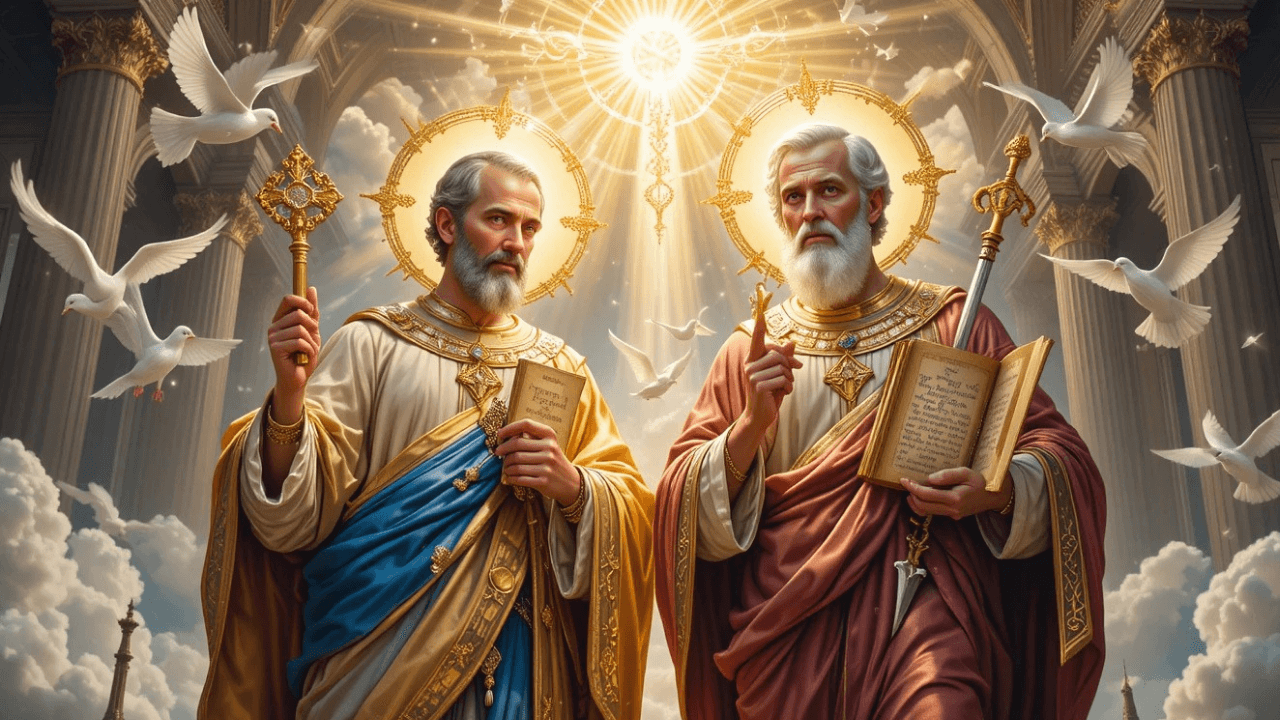
Every year on June 29, Christians around the world celebrate the Feast of Saints Peter and Paul, honoring two of the most influential apostles in the history of the Church. Though their backgrounds could not have been more different, both men played a vital role in spreading the Gospel and shaping early Christianity.
Saint Peter was a humble fisherman chosen by Jesus to lead His followers. Saint Paul was a former persecutor of Christians whose dramatic conversion changed the course of Christian history. Together, they became pillars of faith, courage, and sacrifice.
The story of Saints Peter and Paul is more than a historical account. It is a powerful reminder that God can transform ordinary people and use them for extraordinary purposes. In this guide, you’ll discover who Saints Peter and Paul were, why their feast day is celebrated on June 29, important Bible verses, prayers, novena traditions, and the lasting lessons their lives offer believers today.
What Is the Feast of Saints Peter and Paul?
The Feast of Saints Peter and Paul is celebrated annually on June 29 and commemorates the lives, ministry, and martyrdom of two of Christianity’s greatest apostles. The feast recognizes Saint Peter, the leader of the Apostles and the first Bishop of Rome, and Saint Paul, the missionary who spread the Gospel throughout the Roman Empire.
This important Christian feast highlights the unity of the Church and the universal mission of Christianity. Catholics, Orthodox Christians, and many other Christian denominations observe the day with special prayers, Masses, and reflections on the witness of these two saints.
For believers today, the Feast of Saints Peter and Paul serves as a reminder that faith, repentance, and perseverance can transform lives and inspire future generations.
Who Were Saints Peter and Paul? A Brief Overview
Before we dive into the spiritual depth of their stories, it helps to understand who these two men actually were in history.
Saint Peter: The Rock Who Crumbled — and Was Rebuilt
Peter was born Simon bar Jonah, a fisherman from Bethsaida on the Sea of Galilee. He was loud, impulsive, and deeply loyal — the kind of man who speaks before he thinks and means every word of it. When Jesus called him to follow, Peter didn’t hesitate. He left his nets on the spot.
Jesus gave him the name Peter, from the Greek Petros, meaning “rock.” It was both a declaration and a promise. One day, this rough-edged fisherman would be the foundation on which the Church was built.
But Peter’s path was anything but smooth. He famously walked on water — and then sank the moment he doubted. He decared Jesus the Messiah — and then tried to talk Him out of going to the cross. And on the night of Jesus’s arrest, when a servant girl recognized him as a follower, Peter denied even knowing Jesus. Three times. Just as he had been warned he would.
That moment of denial was the lowest point of Peter’s life. But it wasn’t the end of his story. After the Resurrection, Jesus met Peter on the shore and asked him three times, “Do you love me?” — one restoration for every denial. Peter went on to lead the early Church in Jerusalem, preach at Pentecost, and eventually traveled to Rome, where he was martyred under Emperor Nero around 64–68 AD. According to tradition, he was crucified upside down, saying he was unworthy to die in the same manner as his Lord.
Saint Paul: The Persecutor Turned Proclaimer
Paul’s story is even more dramatic. Born Saul of Tarsus, he was a highly educated Pharisee — a Roman citizen, fluent in Greek, trained in Jewish law, and deeply committed to what he believed was righteous: eliminating the dangerous new sect of Jesus’s followers. He didn’t just disapprove of Christians. He participated in their execution. He stood by while Stephen, the first Christian martyr, was stoned to death.
Then, on the road to Damascus, everything changed.
A blinding light. A voice. “Saul, Saul, why are you persecuting me?” In a single encounter, Saul was undone — left blind, shaken, and utterly transformed. He was led into Damascus, where he fasted for three days before a disciple named Ananias came to him and restored his sight.
After that, Saul became Paul, and Paul became perhaps the most influential missionary in the history of the faith. He traveled more than 10,000 miles across the ancient world — through modern-day Turkey, Greece, and eventually Rome — planting churches, writing letters that would become a third of the New Testament, and enduring shipwrecks, beatings, imprisonment, and constant opposition. He was beheaded in Rome around the same time Peter was crucified, under the same Neronian persecution.
Why Are Peter and Paul Celebrated Together? The Meaning Behind June 29
It might seem strange that two such different men — one a Galilean fisherman, the other a cosmopolitan intellectual — share a single feast day. But that’s precisely the point.
Saints Peter and Paul represent the two great currents of the early Church. Peter was the apostle to the Jewish people, the guardian of the original community of believers in Jerusalem. Paul was the apostle to the Gentiles, the one who carried the gospel far beyond its Jewish roots into the wider Roman world. Together, they represent the full universality of the Christian mission: the faith is for everyone, regardless of background, culture, or past.
Their shared feast day on June 29 has been celebrated since at least the third century. Historical evidence suggests that June 29 may mark the anniversary of the translation of their relics to the catacombs of Rome around 258 AD, during the persecution under Emperor Valerian. In Rome, the feast is observed with particular solemnity — the Pope traditionally celebrates Mass at St. Peter’s Basilica, which stands over the site of Peter’s tomb.
The deeper meaning of celebrating them together is theological as much as historical. The Church holds that neither Peter nor Paul built the Church alone. One provided continuity and authority; the other provided vision and outreach. Their partnership — even when they disagreed, as they famously did at Antioch — models the kind of honest, committed brotherhood the Church needs in every age.
Saints Peter and Paul Bible Verses: Words That Still Speak
Several passages of Scripture are especially associated with these two apostles and are often read on their feast day.
On Peter’s calling and commissioning:
Matthew 16:18 captures the pivotal moment: Jesus turns to Peter and says, “And I tell you that you are Peter, and on this rock I will build my church, and the gates of Hades will not overcome it.” This verse is foundational to the Catholic understanding of apostolic authority.
John 21:15–17 records the beautiful restoration scene after the Resurrection, where Jesus asks Peter three times, “Do you love me?” and commissions him to “Feed my sheep.” It’s a passage soaked in tenderness and second chances.
On Paul’s transformation:
Acts 9:3–6 describes the Damascus road experience: “Suddenly a light from heaven flashed around him. He fell to the ground and heard a voice say to him, ‘Saul, Saul, why do you persecute me?'” This is the hinge moment of Paul’s life — and one of the most dramatic conversion accounts in religious history.
Galatians 1:11–12 is Paul’s own testimony: “I want you to know, brothers and sisters, that the gospel I preached is not of human origin. I did not receive it from any man, nor was I taught it; rather, I received it by revelation from Jesus Christ.”
And perhaps Paul’s most beloved words come from 2 Timothy 4:7, written near the end of his life: “I have fought the good fight, I have finished the race, I have kept the faith.” Those words carry the quiet authority of someone who has earned the right to say them.
The Saints Peter and Paul Prayer and Novena Tradition
Prayer to Saints Peter and Paul is a living tradition in Catholic devotional life, especially in the days leading up to June 29.
A Prayer to Saints Peter and Paul
Holy Apostles Peter and Paul, you gave your lives to plant the seed of the Gospel in the world. Saint Peter, you who were given the keys of the Kingdom, pray for the Church — that it may stand firm on the rock of faith. Saint Paul, you who were knocked to the ground and raised to new purpose, pray for all who are searching — that they may find the light you found on the Damascus road. Together, intercede for us, that we may live with your courage, your honesty about our failures, and your unshakeable trust in the mercy of God. Amen.
The Saints Peter and Paul Novena
A novena is nine days of focused prayer leading up to a feast day. The Saints Peter and Paul Novena typically begins on June 20 and concludes on June 28, the eve of the feast. Each day traditionally focuses on a different aspect of their witness: Peter’s faith, Peter’s repentance, Paul’s conversion, Paul’s missionary zeal, their shared martyrdom, their intercession for the Church, their unity in diversity, their courage under persecution, and their ongoing presence as patrons of the universal Church.
Many parishes and online communities pray the novena together. It’s a powerful way to enter into the feast not just as a liturgical date on a calendar, but as a lived spiritual experience.
What Their Story Means for Us Today
This is the question that matters most: So what?
We live in a world that is deeply skeptical of institutions, including the Church. We live in a time when many people carry shame about their past — things they’ve done, people they’ve hurt, identities they’ve run from. And we live in a culture that values confidence and polish, that finds it hard to trust people who have failed spectacularly.
Saints Peter and Paul speak directly into all of that.
Peter says: You can fail the people you love most, in their darkest hour, and still be restored. Shame is not the final word.
Paul says: The very thing you’re most ashamed of — your opposition to what is good, your years of walking in the wrong direction — can become the very thing that gives your witness its power. I know what it is to be wrong. That’s exactly why I know what it means to be forgiven.
Together, they say something the world desperately needs to hear: transformation is real. Nobody is too far gone. And the work of love, done faithfully over years, can outlast every empire.
FAQ: Common Questions About Saints Peter and Paul
Q: Why is the Feast of Saints Peter and Paul on June 29? June 29 has been associated with Peter and Paul since the third century, likely connected to the transfer of their relics to the Appian Way in Rome around 258 AD during a period of persecution. It has been a major liturgical celebration ever since.
Q: Are Saints Peter and Paul patrons of anything specific? Yes. Saint Peter is the patron of fishermen, net makers, and popes. Saint Paul is the patron of writers, theologians, publishers, and public relations workers. Together, they are considered co-patrons of Rome, and the feast is a national holiday in several countries including Italy, Malta, and the Vatican.
Q: Did Peter and Paul ever meet in person? Yes. Paul recounts in his letter to the Galatians that he traveled to Jerusalem specifically to meet Peter, spending fifteen days with him (Galatians 1:18). Later, they had a famous public disagreement at Antioch over the question of table fellowship between Jewish and Gentile Christians (Galatians 2:11–14). Their relationship was real, complex, and honest — the kind of brotherhood built not on flattery but on shared conviction.
Q: Is June 29 a holy day of obligation? In many countries it is a solemnity and a public holiday, particularly in Italy and Malta. Whether it is a holy day of obligation varies by country and diocese. Catholics are encouraged to check with their local parish.
Q: Where are Saints Peter and Paul buried? According to ancient tradition confirmed by archaeological excavations, Saint Peter is buried beneath the high altar of St. Peter’s Basilica in Vatican City. Saint Paul’s remains are believed to rest beneath the Basilica of Saint Paul Outside the Walls in Rome, where a tomb inscription has been identified by archaeologists. Both sites have been venerated since the earliest centuries of Christianity.
People Also Ask
Why are Saints Peter and Paul celebrated together?
Saints Peter and Paul are celebrated together because both played essential roles in establishing and spreading the Christian faith. Peter led the early Church, while Paul carried the Gospel to the Gentile world. Their shared witness and martyrdom in Rome unite them in Christian tradition.
What is the meaning of Saints Peter and Paul?
The meaning of Saints Peter and Paul lies in transformation and faithfulness. Peter represents forgiveness and restoration after failure, while Paul represents conversion and spiritual renewal. Together, they show that God’s grace can change any life.
When is the Feast of Saints Peter and Paul?
The Feast of Saints Peter and Paul is celebrated every year on June 29.
What is the prayer to Saints Peter and Paul?
A prayer to Saints Peter and Paul asks for their intercession, courage, wisdom, and steadfast faith. Christians often pray for strength to follow Christ despite challenges and difficulties.
How did Saints Peter and Paul die?
According to Christian tradition, Saint Peter was crucified upside down in Rome, while Saint Paul was beheaded during the persecution of Christians under Emperor Nero.
Conclusion: Their Story Is Still Being Written — Through Us
The Feast of Saints Peter and Paul on June 29 is more than a date. It’s an invitation.
It’s an invitation to look honestly at our own failures — our denials, our persecutions, our years of walking in the wrong direction — and to believe that none of that disqualifies us from being used. It’s an invitation to hold together the things that seem opposed: tradition and innovation, roots and mission, the local and the universal.
Most of all, it’s an invitation to trust that the same God who turned a frightened fisherman into the Rock of the Church, and a murderous zealot into the apostle of mercy, is still in the business of transformation.
This June 29, take a few minutes to pray the feast day prayer, read one of the Bible passages above, or simply sit with the question Peter and Paul both had to answer: Do I really believe that God can use even me?
The answer, across two thousand years of history, is an unambiguous yes.
Internal linking opportunities: Link “Peter’s denial” to a related article on repentance and forgiveness; link “Damascus road” to a deeper piece on conversion stories; link “novena” to a prayer resources page; link “Feast Day” to a liturgical calendar overview.
25 Powerful Prayer for Healing the sick

Role: Founder & Spiritual Writer at TheGodMessage.com
About: Himanshu is a Jesus-centered writer known for creating clear, uplifting, and Bible-rooted content for modern believers.
Expertise: specializes in prayers, devotionals, and spiritual guidance designed to help readers grow stronger in faith no matter where they are in life.
Purpose: His mission is to inspire readers to connect with their inner self, experience peace, and understand the messages of the universe. “My mission is simple, to bring God’s light into your everyday life.”