

Most of us learned a mealtime prayer before we understood a word of it. Someone taught it to us at a table, we repeated it, and it stayed.
This page gathers short Grace Before Meals you can actually use — for family dinners, for eating alone, for a restaurant, for a table where not everyone shares your faith — along with the traditional blessings and where they came from. But it starts with something the Bible shows about mealtime prayer that is almost never pointed out.
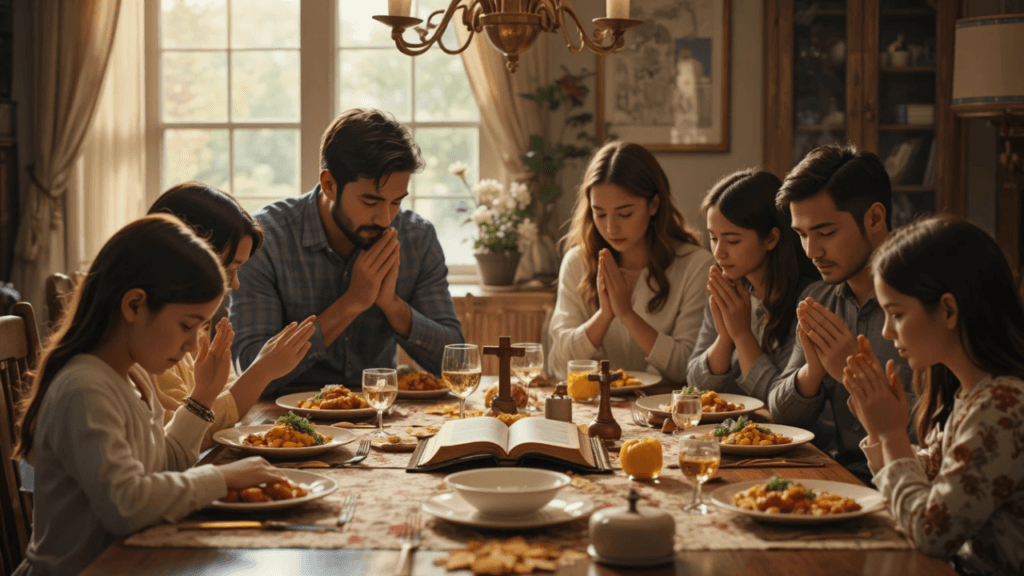
Why is it called “saying grace”?
The word has nothing to do with saving grace.
It comes from the Latin gratia, meaning thanks or favor. The old phrase was gratiarum actio — “an act of thanks.” English shortened it, and for centuries people spoke of saying “graces” at a table the way we might say “thanks.”
Worth knowing: the King James Bible never uses the word grace to mean a mealtime prayer. Not once. In the KJV, “grace” always means God’s unmerited favor. When Scripture describes someone praying at a table, it uses two different words — blessed and gave thanks.
That is a small point, but it clears up a confusion many people carry for years without ever asking about it.
What Scripture actually records
Here is where it gets interesting. The Bible records several occasions when Jesus or Paul prayed before eating. Look at what the text says — and at what it does not say.
| Passage | What the KJV records |
|---|---|
| Matthew 14:19 | “…looking up to heaven, he blessed, and brake, and gave the loaves to his disciples” |
| Matthew 15:36 | “…he took the seven loaves and the fishes, and gave thanks, and brake them” |
| Mark 8:6 | “…he took the seven loaves, and gave thanks, and brake, and gave to his disciples” |
| Luke 24:30 | “…he took bread, and blessed it, and brake, and gave to them” |
| John 6:11 | “And Jesus took the loaves; and when he had given thanks, he distributed to the disciples” |
| Acts 27:35 | “…he took bread, and gave thanks to God in presence of them all” |
Six passages. And in not one of them are the words of the prayer recorded.
We are told that He looked up. We are told that He blessed, that He gave thanks, that He did it in front of everybody. We are never told what He said.
That silence is doing something. If there were one correct formula, Scripture had six clear opportunities to give it to us and declined every time. What is recorded is the posture — thanks given, aloud, before eating, acknowledged openly — and the words are left to you.
So if you have ever felt that your mealtime prayer is too plain, or that you ought to be using the proper one: there isn’t a proper one. There never was.
The command most people miss
Here is the second surprise. The clearest direct instruction in Scripture about giving thanks for food is not about praying before the meal at all.
Deuteronomy 8:10 (KJV) — “When thou hast eaten and art full, then thou shalt bless the LORD thy God for the good land which he hath given thee.”
Eaten. And full. Then bless Him.
This is the verse behind the Jewish practice of grace after meals, and it carries an obvious logic. It is easy to be grateful when you are hungry and the food is in front of you. It is harder to remember God when the plate is empty and you are comfortable and already thinking about the next thing.
None of this argues against praying before a meal. Jesus plainly did, and so did Paul. But it is worth knowing that if anyone asks you for chapter and verse on mealtime thanks, the strongest text points to afterwards — and that most Christian households have quietly dropped the half of the practice Scripture is most direct about.
There is a short grace after meals at the end of this page if you want to recover it.
Are we blessing the food, or blessing God?
A fair question, and the answer is tidier than you might expect.
1 Timothy 4:4-5 (KJV) — “For every creature of God is good, and nothing to be refused, if it be received with thanksgiving: For it is sanctified by the word of God and prayer.”
Food is already good because God made it. Prayer does not repair it or make it safe. What the prayer does is receive it rightly — it sets an ordinary plate of food into its proper place as a gift rather than a given.
So when a prayer says “bless this food,” it is a shorthand, not a magic formula. The older Jewish blessings were addressed to God for the food rather than to the food itself, and that is the better instinct. You are not changing the meal. You are changing where your attention sits while you eat it.
Short Grace Before Meals
These are deliberately brief. A grace that runs long tends not to get said at all.
The simplest
Father, we thank You for this food. Bless it to our bodies and us to Your service, in Jesus’ name. Amen.
Thanks for the hands that made it
Lord, thank You for this meal and for the hands that prepared it. Thank You for providing again today. Amen.
For the table and the people at it
Father, thank You for this food and for everyone around this table. Bless our time together and our conversation. In Jesus’ name, Amen.
Remembering those who have less
Lord, we thank You for what is set before us. Make us mindful of those who have no meal today, and willing to be part of Your answer to them. Amen.
When you are in a hurry
Thank You, Lord, for this food. Amen.
That last one counts. A short, honest sentence is a real prayer.
Graces for particular situations
Eating alone
Father, I thank You for this food, and for Your provision. Thank You that I am never actually eating alone. Amen.
At a restaurant or in public
Lord, thank You for this meal and for the people who made it and served it. Bless them today. In Jesus’ name, Amen.
When not everyone at the table shares your faith
Father, we thank You for this food, for this home, and for the people gathered here. We are grateful. Amen.
Short, warm, unmistakably a prayer, and it asks nothing of anyone else. The worst mealtime prayer is one that makes a guest feel examined.
When money is tight
Lord, You have provided again. Thank You for what is here. Teach us to trust You for tomorrow as well. Amen.
For a Sunday or fellowship meal
Father, we thank You for this food and for the fellowship of Your people. Bless this time together, and let our conversation honor You. In Jesus’ name, Amen.
A birthday meal
Lord, we thank You for this food, and we thank You for the year You have given to [name]. Bless the year ahead and keep them close to You. Amen.
A grace a child can lead
Thank You, God, for this food. Thank You for my family. Amen.
Traditional graces, and where they came from
These are the ones you have heard. Almost every page that reprints them leaves out the attribution, which is a shame, because the origins are part of what makes them worth saying.
“God is great, God is good”
God is great, God is good, Let us thank Him for our food. By His hand we all are fed, Give us, Lord, our daily bread. Amen.
Author unknown, and widely used in American homes for well over a century. The closing line comes straight from the Lord’s Prayer — “Give us this day our daily bread” (Matthew 6:11, KJV).
“Be present at our table, Lord”
Be present at our table, Lord; Be here and everywhere adored. These mercies bless, and grant that we May feast in paradise with Thee.
Written by John Cennick in 1741, an early Methodist and later Moravian preacher. One of the oldest English graces still in common use, and it is a hymn verse rather than a prose prayer, which is why it scans so well aloud.
“Come, Lord Jesus, be our guest”
Come, Lord Jesus, be our guest, And let these gifts to us be blessed. Amen.
Long associated with Lutheran homes and often attributed to Martin Luther, though the attribution is traditional rather than documented.
The Selkirk Grace
Some hae meat and canna eat, And some wad eat that want it; But we hae meat, and we can eat, Sae let the Lord be thankit.
Scots, traditionally attributed to Robert Burns and recited at Burns suppers to this day, though it is likely older than he is. “Meat” here means food in general, the same way the KJV uses it in Psalm 145:15.
“Bless us, O Lord”
Bless us, O Lord, and these Thy gifts, which we are about to receive from Thy bounty, through Christ our Lord. Amen.
This is the most widely reprinted grace in English, and it is worth knowing where it comes from: it is a translation of the medieval Latin Benedic, Domine, nos et haec tua dona, and it is the standard Catholic table blessing. Protestant sites reproduce it constantly without saying so.
There is nothing in the words themselves a Protestant believer need object to — it thanks God, names Christ, and claims nothing unscriptural. But if you would rather use something from your own tradition, the Cennick verse above is roughly the same age and does the same work.
A grace after the meal
Following Deuteronomy 8:10. This takes about ten seconds and almost nobody does it anymore.
Lord, we have eaten and we are satisfied. We thank You for Your provision, and we bless Your name for it. Keep us from forgetting You now that we are full. In Jesus’ name, Amen.
If you want to add a verse, this one belongs here:
Psalm 136:25 (KJV) — “Who giveth food to all flesh: for his mercy endureth for ever.”
KJV verses for the table
Any of these can be read instead of a prayer, or before one. A verse read aloud works especially well when a family has been saying the same four lines for ten years and nobody is hearing them anymore.
Psalm 145:15-16 — “The eyes of all wait upon thee; and thou givest them their meat in due season. Thou openest thine hand, and satisfiest the desire of every living thing.”
1 Corinthians 10:31 — “Whether therefore ye eat, or drink, or whatsoever ye do, do all to the glory of God.”
1 Thessalonians 5:18 — “In every thing give thanks: for this is the will of God in Christ Jesus concerning you.”
1 Timothy 4:4-5 — “For every creature of God is good, and nothing to be refused, if it be received with thanksgiving: For it is sanctified by the word of God and prayer.”
Psalm 104:14-15 — “He causeth the grass to grow for the cattle, and herb for the service of man: that he may bring forth food out of the earth… and bread which strengtheneth man’s heart.”
Acts 2:46 — “…and breaking bread from house to house, did eat their meat with gladness and singleness of heart.”
Romans 14:6 — “…he that eateth, eateth to the Lord, for he giveth God thanks.”
James 1:17 — “Every good gift and every perfect gift is from above, and cometh down from the Father of lights.”
Matthew 6:11 — “Give us this day our daily bread.”
Deuteronomy 8:10 — “When thou hast eaten and art full, then thou shalt bless the LORD thy God for the good land which he hath given thee.”
Teaching children to say grace
A few things that tend to work.
Start with four words. “Thank You, God. Amen.” A three-year-old can carry that, and carrying it matters more than the content.
Let them take a turn. Children who only ever hear grace said at them often stop hearing it. Children who get asked to say it start paying attention.
Explain the word once. “Grace just means thanks.” It takes five seconds and saves years of vague confusion.
Add one named thing. “Thank You for this food, and thank You for Grandma.” Naming something specific is what turns a recitation back into a prayer.
Don’t make it a performance. If a child mumbles it or rushes it, let it go. The habit is the goal, not the delivery.
If you are looking for prayers for other family and church occasions, you may also find our [INTERNAL LINK: Prayers for a Church Meeting] and [INTERNAL LINK: Bible Verses About Hope, Strength and Peace] useful.
Frequently asked questions
Does the Bible command us to pray before meals?
There is no direct command to pray before eating. Jesus and Paul both did it, and Scripture records it plainly, which is strong precedent. The one explicit instruction — Deuteronomy 8:10 — concerns blessing God after eating.
Is “saying grace” a Catholic thing?
No. The practice predates the division entirely and is older than Christianity, going back to Jewish table blessings. The specific prayer “Bless us, O Lord” is Catholic in origin, but the practice itself belongs to all Christians.
What is the shortest acceptable grace?
“Thank You, Lord, for this food. Amen.” Scripture never prescribes a length, and the one record of Paul praying before a meal happened on a sinking ship in front of a crew of pagan sailors (Acts 27:35). Brevity is not the problem.
Should I say grace in a restaurant? That is your call and not a matter of obedience. Acts 27:35 notes that Paul gave thanks “in presence of them all,” so there is clear precedent for praying in public. A short quiet prayer counts just as much as a spoken one.

What if I don’t know what to say?
Say thank you for the food, ask God’s blessing on it, and stop. That is the whole structure of every grace on this page.
Should children be made to say grace?
Invited, yes. Forced, probably not. A habit formed under pressure rarely survives the teenage years.
Does praying over food actually do something to it?
According to 1 Timothy 4:4-5, food is already good because God made it. Prayer receives it with thanksgiving rather than altering it.
Is grace after meals still practiced?
In Jewish homes, widely — the Birkat HaMazon comes directly from Deuteronomy 8:10. Among Christians it has largely fallen away, though some liturgical traditions retain it.
In closing
There is a reason Scripture never recorded the words.
Six times the Gospels and Acts put us at a table with Jesus or Paul, and six times we are told only that thanks were given. The Bible seems far more concerned that we stop than that we say the right thing when we do.
So whichever of these you use — or none of them, and your own plain sentence instead — the pausing is the practice.
1 Thessalonians 5:18 (KJV) — “In every thing give thanks: for this is the will of God in Christ Jesus concerning you.”

Role: Founder & Spiritual Writer at TheGodMessage.com
About: Himanshu is a Jesus-centered writer known for creating clear, uplifting, and Bible-rooted content for modern believers.
Expertise: specializes in prayers, devotionals, and spiritual guidance designed to help readers grow stronger in faith no matter where they are in life.
Purpose: His mission is to inspire readers to connect with their inner self, experience peace, and understand the messages of the universe. “My mission is simple, to bring God’s light into your everyday life.”