
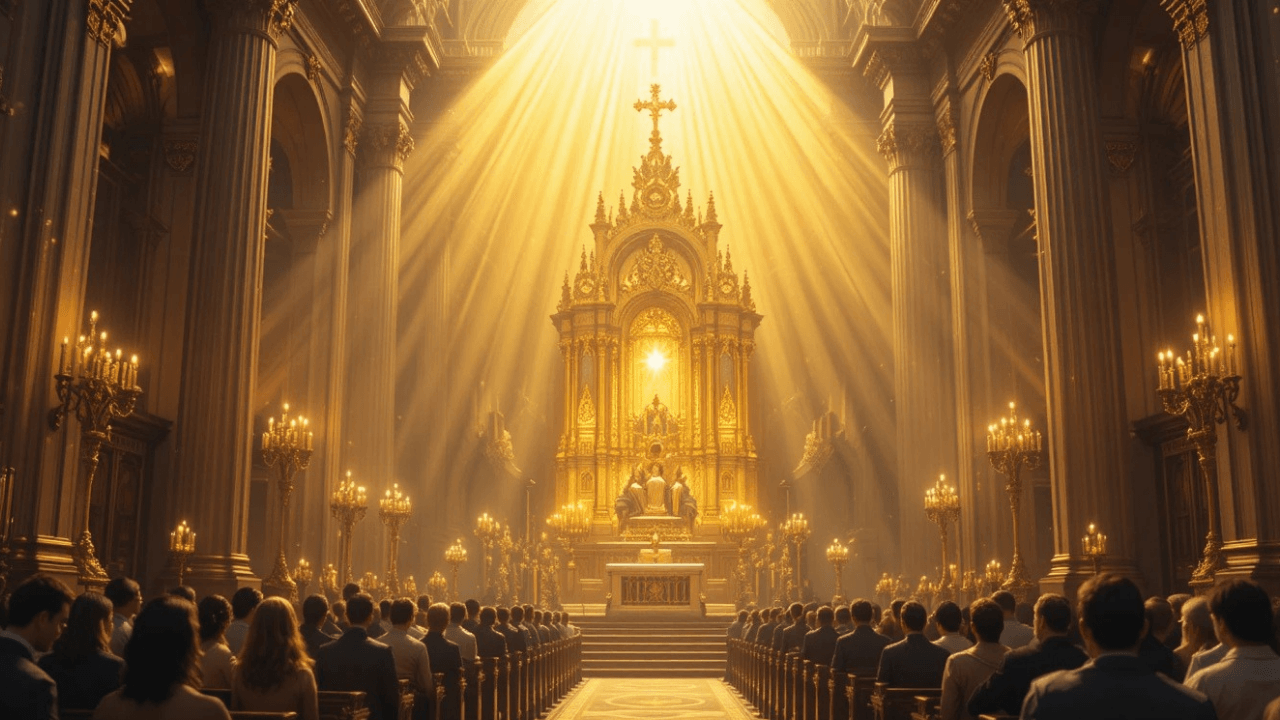
The air hums with anticipation. Candles flicker against the evening sky as families line the streets, their faces soft in the golden glow. Then comes the moment that always steals your breath — the golden monstrance appears, lifted high, and inside rests the white Host. In that fragile circle of bread, Catholics believe the entire Jesus stands before them: the One who calmed storms, healed the broken, and conquered death.
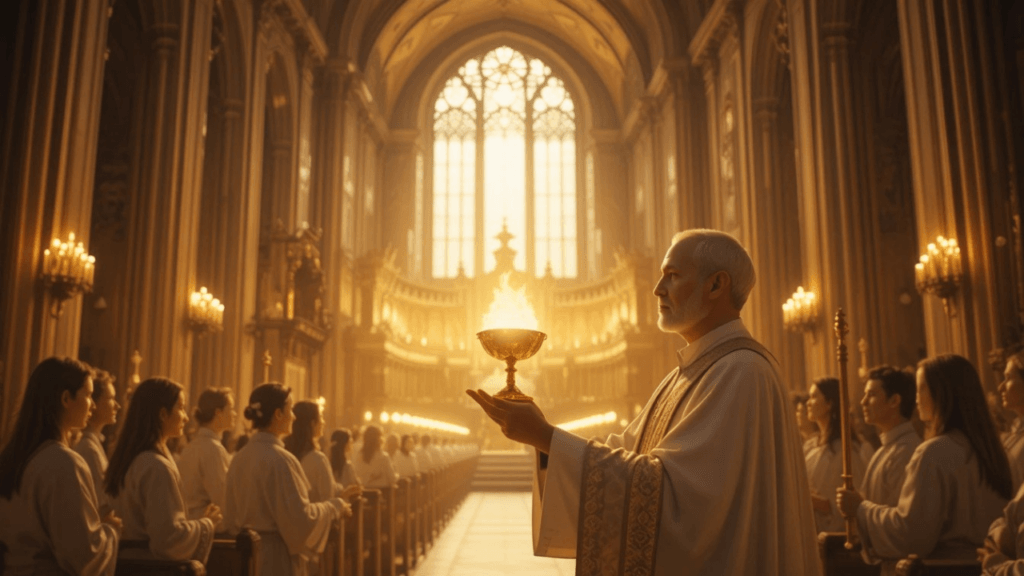
For many of us, the Feast of Corpus Christi isn’t just a feast. It’s a homecoming. A quiet rebellion against a noisy, distracted world that tells us we’re alone. Here, Christ says otherwise — loudly, humbly, and with love so deep it chooses to stay small enough to fit on our tongues.
What Is the Feast of Corpus Christi?
“Corpus Christi” simply means “Body of Christ.” This solemnity celebrates the profound Catholic teaching of the Real Presence: that Jesus is truly, substantially present — Body, Blood, Soul, and Divinity — in the Holy Eucharist.
It’s not a symbol or a nice memory. It is Jesus Himself, continuing to give everything for us, just as He did on the Cross. The feast calls us to fall in love again with the God who refuses to leave us orphans.
Why Is Feast of Corpus Christi Celebrated on Thursday?
The feast falls on Thursday because it recalls Maundy Thursday, the day Jesus instituted the Eucharist at the Last Supper. By celebrating it on a separate Thursday (the Thursday after Trinity Sunday), the Church gives this mystery its own joyful spotlight — free from the sorrow of the Passion. In 2026, that lands on Thursday, June 4, though many places observe it on Sunday, June 7 for wider participation.
When Is Corpus Christi 2026?
- Traditional date: Thursday, June 4, 2026
- Observed on Sunday in countries like the United States, UK, and others: June 7, 2026
From the flower-carpeted villages of Poland to bustling cities in Brazil, hearts turn toward the same Lord.
Is Corpus Christi Mentioned in the Bible?
While the specific feast isn’t named, its heart beats throughout Scripture. Jesus’ own words in John 6 — the Bread of Life discourse — lay the foundation. When He said, “My flesh is true food and my blood is true drink,” many disciples walked away. But the Church has never forgotten. The feast exists to help us stay.
History of the Feast of Corpus Christi
In the 13th century, a quiet Belgian nun named St. Juliana of Liège kept having the same haunting vision: a full moon with one dark spot. She understood it as the Church missing a special feast to honor the Blessed Sacrament.
Her persistence reached the ears of a man who would become Pope Urban IV. In 1264, he established the feast for the whole Church. He asked St. Thomas Aquinas to write the texts — and what emerged were some of the most soaring hymns in Christian history, including Pange Lingua and Tantum Ergo.
What began as a lonely vision in a convent has become a public explosion of love that still fills streets worldwide.
Why Corpus Christi Still Moves Hearts Today
I remember as a child watching my first Eucharistic procession. The priest carried the monstrance slowly, and the people sang with a tenderness I rarely heard in daily life. My grandmother clutched her rosary, tears in her eyes. At that moment, something shifted inside me — I felt seen. Not by the crowd, but by the One they carried.
Years later, sitting alone in an adoration chapel during a dark season of loss, I found the same presence. The church was silent except for the soft tick of a candle. No grand music. Just Him. And somehow, that silent gaze was enough to keep me going.
In our age of anxiety and spiritual hunger, young Catholics especially are returning to adoration chapels. The National Eucharistic Revival in recent years has seen thousands — including many in their 20s and 30s — rediscovering the peace that only Christ in the Eucharist can give. The world offers noise. Corpus Christi offers presence.
What Is a Monstrance?
A monstrance is that beautiful, sunburst-like vessel that holds the consecrated Host for public veneration. Its name comes from the Latin monstrare — “to show.” It literally shows Jesus to the world. Often made of gold with rays extending outward, it reminds us that Christ is the light shining in our darkness.
What Happens During Eucharistic Adoration?
You enter the chapel or church. The Host is placed in the monstrance on the altar. Then comes the most radical act in our noisy world: you simply stay.
Some read Scripture. Others journal. Many just sit and look — or let themselves be looked at. There is no performance. No pressure. Just two hearts meeting: yours and His. Many leave feeling lighter, as if invisible weights have been lifted.
Most Beautiful Corpus Christi Traditions in the World
The feast explodes with color and devotion across cultures:
Flower Carpets of Poland and Beyond In Spycimierz, Poland, villagers create living carpets of flowers stretching over a kilometer long. The procession walks on this fragrant path of petals — a UNESCO-recognized tradition of breathtaking beauty. Similar carpets appear in Portugal, Spain, and Latin America.
Grand Processions In Spain, especially Catalonia, processions include traditional dances, music, and even fireworks. In Italy and Latin America, entire towns turn out with banners, incense, and hymns.
Quiet Adoration Nights In many places, especially among young people today, the feast includes extended hours of adoration with contemporary worship music blending with ancient chants.
Famous Eucharistic Miracles Connected to Feast of Corpus Christi
Some stories stop you cold.
In Bolsena, Italy, in 1263, a priest doubting the Real Presence watched in horror and wonder as the Host began to bleed during Mass. Blood stained the corporal. That miracle, preserved in Orvieto, helped inspire the universal feast.
In Lanciano, centuries earlier, the bread visibly became human flesh and the wine became blood. Scientific tests in modern times confirmed it was heart tissue — alive, with blood type AB.
And in Buenos Aires in 1996, a Host left in a container turned into bleeding flesh. Again, tests showed living heart tissue. The same blood type.
These aren’t fairy tales. They are love letters written in flesh and blood, begging us to believe.
Bible Verses About Corpus Christi and the Eucharist
John 6:51 “I am the living bread… Whoever eats this bread will live forever.”
Luke 22:19 “This is my body given for you; do this in remembrance of me.”
These words are not distant history. They are an invitation extended to you today.
Powerful Prayers for the Feast of Corpus Christi
Simple Prayer of the Hear
“Jesus, hidden in the Eucharist, I believe in Your love for me. When I feel empty, fill me. When I feel lost, stay with me.”
St. Thomas Aquinas
“O sacred banquet, in which Christ is received…”
For Those Who Suffer
“Lord, You know my pain better than I do. Come to me in this Host and carry what I cannot.”
Inspiring Corpus Christi Quotes
“The Eucharist is the source and summit of the Christian life.” — Vatican II
“If you want to change the world, go to Adoration.” — St. Teresa of Calcutta (paraphrased)
Simple Ways to Draw Closer to Jesus This Corpus Christi
- Attend Mass and receive Communion with fresh awareness.
- Spend even 15 minutes in Eucharistic Adoration.
- Join or watch a procession (many are streamed live).
- Create a small home altar and pray as a family.
- Perform hidden acts of kindness — seeing Christ in others.
Corpus Christi Symbols and Their Meaning
- Monstrance: Christ revealed to the world.
- White and Gold: Purity and glory.
- Flowers: Beauty offered back to the Creator.
- Procession: The Church walking boldly with Jesus through everyday streets.
What Corpus Christi Teaches a Hurting World
Even when churches feel empty and hearts grow weary, the Eucharist remains a quiet flame that refuses to go out. It teaches us that God’s love is not loud or flashy — it is steady, humble, and faithful. It nourishes us when nothing else can. It unites us when the world divides.
Frequently Asked Questions
What does Corpus Christi mean? “Body of Christ” — honoring Jesus’ Real Presence in the Eucharist.
Is Corpus Christi a holy day of obligation? It depends on the country. In many places it is encouraged but not always obligatory.
What are the symbols of Corpus Christi? The monstrance, Host, flowers, and processions.
Which countries celebrate Corpus Christi with public holidays? Poland, Spain, Brazil, Portugal, and several others.
A Final Invitation
Long after the hymns fade and the last candle flickers out, the Eucharist remains. Silent. Patient. Loving.
In 2026, as processions wind through cities and villages once more, may you find yourself drawn closer to this astonishing truth: the God of the universe waits for you — every single day — in the Blessed Sacrament.
He sees your struggles. He carries your tears. And He still chooses to stay.
Come. He is here.
35 Powerful Bible Verses Faith, Hope and love

Role: Founder & Spiritual Writer at TheGodMessage.com
About: Himanshu is a Jesus-centered writer known for creating clear, uplifting, and Bible-rooted content for modern believers.
Expertise: specializes in prayers, devotionals, and spiritual guidance designed to help readers grow stronger in faith no matter where they are in life.
Purpose: His mission is to inspire readers to connect with their inner self, experience peace, and understand the messages of the universe. “My mission is simple, to bring God’s light into your everyday life.”