
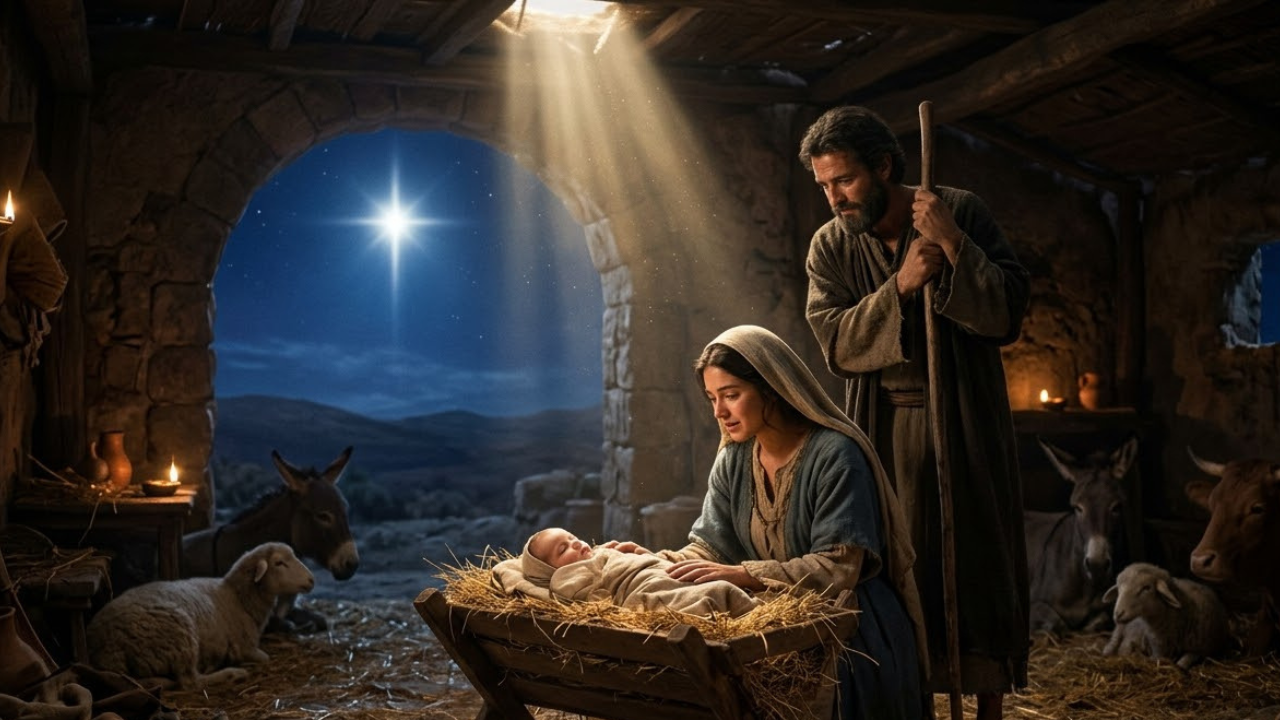
The Bible does not open the Christmas story in a stable. It opens it centuries earlier, with a promise spoken in a garden and repeated by prophets who never saw it happen. By the time Luke writes “there was no room for them in the inn,” the reader has been waiting a very long time.
This collection gathers the Bible verses about the birth of Jesus in the King James Version and places them in the order the story actually unfolds. Each section keeps the KJV wording intact, followed by a short note on what the passage shows and why it matters.
Here is what you will find below:
- The Old Testament prophecies that pointed to His birth
- The angel’s announcements to Mary and to Joseph
- The night in Bethlehem, word for word from Luke 2
- The shepherds, Simeon, Anna, and the wise men
- A “Who Heard the News First” table of every witness and how each one responded
- What the New Testament says the birth means
- A simple Christmas Eve read-aloud order for families and Sunday school classes
Matthew and Luke tell the story from two angles. Matthew follows Joseph — his dreams, his decisions, his flight into Egypt. Luke follows Mary — her questions, her song, the things she “pondered in her heart.” Reading both side by side gives the fullest picture, and that is how the verses are arranged here.
Old Testament Prophecies About the Birth of Jesus (KJV)
The prophets spoke of the coming Child long before Bethlehem. These are the passages the New Testament writers themselves pointed back to.
Genesis 3:15 — The first promise
“And I will put enmity between thee and the woman, and between thy seed and her seed; it shall bruise thy head, and thou shalt bruise his heel.”
Spoken right after the fall, this is often called the first gospel. Notice the phrase “her seed” — an unusual way to describe a descendant, and one that Christians have long read in light of the virgin birth.
Isaiah 7:14 — Born of a virgin
“Therefore the Lord himself shall give you a sign; Behold, a virgin shall conceive, and bear a son, and shall call his name Immanuel.”
Matthew quotes this verse directly when he describes Mary’s pregnancy (Matthew 1:23). The name Immanuel is explained there for us: “God with us.”
Isaiah 9:6 — The Child and His names
“For unto us a child is born, unto us a son is given: and the government shall be upon his shoulder: and his name shall be called Wonderful, Counsellor, The mighty God, The everlasting Father, The Prince of Peace.”
A child is born, but a Son is given. The two halves of the line hold both truths of Christmas together — a real human birth, and a Son who existed before it.
Isaiah 9:2 — Light in the darkness
“The people that walked in darkness have seen a great light: they that dwell in the land of the shadow of death, upon them hath the light shined.”
Micah 5:2 — The town of Bethlehem
“But thou, Bethlehem Ephratah, though thou be little among the thousands of Judah, yet out of thee shall he come forth unto me that is to be ruler in Israel; whose goings forth have been from of old, from everlasting.”
This is the verse the chief priests quoted to Herod when the wise men asked where the King had been born (Matthew 2:5-6). Bethlehem was small. The One born there was “from everlasting.”
Isaiah 11:1 — From the family of David
“And there shall come forth a rod out of the stem of Jesse, and a Branch shall grow out of his roots:”
Jesse was King David’s father. By Jesus’ day, David’s royal line looked like a cut-down stump — and a Branch was promised to grow from it anyway.
Jeremiah 23:5 — A righteous King
“Behold, the days come, saith the LORD, that I will raise unto David a righteous Branch, and a King shall reign and prosper, and shall execute judgment and justice in the earth.”
Hosea 11:1 — Called out of Egypt
“When Israel was a child, then I loved him, and called my son out of Egypt.”
Matthew connects this verse to the young family’s return from Egypt after Herod’s death (Matthew 2:15).
Prophecy and fulfillment at a glance
| Prophecy (KJV) | What was promised | Where it was fulfilled |
| Isaiah 7:14 | Born of a virgin | Matthew 1:18-23; Luke 1:34-35 |
| Micah 5:2 | Born in Bethlehem | Matthew 2:1-6; Luke 2:4-7 |
| Isaiah 11:1; Jeremiah 23:5 | From the line of David | Luke 1:32; Luke 2:4 |
| Hosea 11:1 | Called out of Egypt | Matthew 2:14-15 |
| Isaiah 9:2 | A great light for those in darkness | Luke 2:32; John 1:4-5 |
The Announcement: Gabriel Comes to Mary (KJV)
Luke begins in an ordinary town, with an ordinary young woman who is about to be married.
Luke 1:26-27
“And in the sixth month the angel Gabriel was sent from God unto a city of Galilee, named Nazareth, To a virgin espoused to a man whose name was Joseph, of the house of David; and the virgin’s name was Mary.”
Luke 1:30-33
“And the angel said unto her, Fear not, Mary: for thou hast found favour with God. And, behold, thou shalt conceive in thy womb, and bring forth a son, and shalt call his name JESUS. He shall be great, and shall be called the Son of the Highest: and the Lord God shall give unto him the throne of his father David: And he shall reign over the house of Jacob for ever; and of his kingdom there shall be no end.”
The promise to David from 2 Samuel 7 — a throne that would last forever — is restated here in a single sentence to a teenager in Galilee.
Luke 1:34-35
“Then said Mary unto the angel, How shall this be, seeing I know not a man? And the angel answered and said unto her, The Holy Ghost shall come upon thee, and the power of the Highest shall overshadow thee: therefore also that holy thing which shall be born of thee shall be called the Son of God.”
Mary’s question is honest and practical. She does not doubt God; she asks how. The answer points entirely to the work of the Holy Ghost.
Luke 1:37-38
“For with God nothing shall be impossible. And Mary said, Behold the handmaid of the Lord; be it unto me according to thy word. And the angel departed from her.”
Verse 37 is one of the most-quoted lines in all of Luke. In context, it is the angel’s answer to a question no one had ever needed to ask before.
Luke 1:46-47 — Mary’s song
“And Mary said, My soul doth magnify the Lord, And my spirit hath rejoiced in God my Saviour.”
Mary calls God “my Saviour.” Her song (Luke 1:46-55) is full of Old Testament language, especially from Hannah’s prayer in 1 Samuel 2.
Joseph’s Dream: The Birth of Jesus in Matthew (KJV)
Matthew tells the same events from Joseph’s side — and Joseph’s first reaction was to quietly end the engagement.
Matthew 1:18
“Now the birth of Jesus Christ was on this wise: When as his mother Mary was espoused to Joseph, before they came together, she was found with child of the Holy Ghost.”
Matthew 1:20-21
“But while he thought on these things, behold, the angel of the LORD appeared unto him in a dream, saying, Joseph, thou son of David, fear not to take unto thee Mary thy wife: for that which is conceived in her is of the Holy Ghost. And she shall bring forth a son, and thou shalt call his name JESUS: for he shall save his people from their sins.”
The name itself is the mission. “Jesus” is the Greek form of the Hebrew name Joshua, which means “the LORD saves.” The angel spells it out: He shall save His people from their sins.
Matthew 1:22-23
“Now all this was done, that it might be fulfilled which was spoken of the Lord by the prophet, saying, Behold, a virgin shall be with child, and shall bring forth a son, and they shall call his name Emmanuel, which being interpreted is, God with us.”
Matthew 1:24-25
“Then Joseph being raised from sleep did as the angel of the Lord had bidden him, and took unto him his wife: And knew her not till she had brought forth her firstborn son: and he called his name JESUS.”
Joseph never speaks a single recorded word in the Bible. What Scripture records instead is obedience — four times in Matthew 1-2, he is told something in a dream and simply does it.
The Night in Bethlehem: Luke 2 KJV
This is the passage most families know by heart. It moves from an emperor’s decree to a feeding trough in just seven verses.
Luke 2:1
“And it came to pass in those days, that there went out a decree from Caesar Augustus, that all the world should be taxed.”
The most powerful man on earth signed an order about taxes. He had no idea he was moving a carpenter and his pregnant wife to the exact town Micah had named seven hundred years earlier.
Luke 2:4-5
“And Joseph also went up from Galilee, out of the city of Nazareth, into Judaea, unto the city of David, which is called Bethlehem; (because he was of the house and lineage of David:) To be taxed with Mary his espoused wife, being great with child.”
Luke 2:6-7
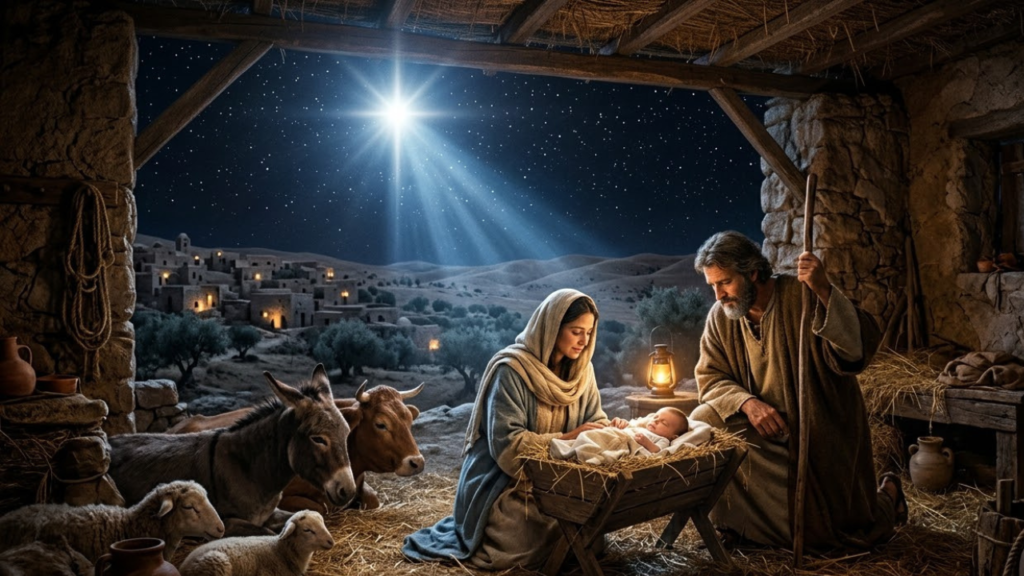
“And so it was, that, while they were there, the days were accomplished that she should be delivered. And she brought forth her firstborn son, and wrapped him in swaddling clothes, and laid him in a manger; because there was no room for them in the inn.”
Luke gives the birth itself one sentence. No crowd, no description of the room — just a mother, cloth wrappings, and a manger, which was an animal’s feeding trough. The King of the Jews spent His first night where livestock ate.
The Shepherds and the Angels (KJV)
The first birth announcement went to men working the night shift.
Luke 2:8-9
“And there were in the same country shepherds abiding in the field, keeping watch over their flock by night. And, lo, the angel of the Lord came upon them, and the glory of the Lord shone round about them: and they were sore afraid.”
Luke 2:10-11
“And the angel said unto them, Fear not: for, behold, I bring you good tidings of great joy, which shall be to all people. For unto you is born this day in the city of David a Saviour, which is Christ the Lord.”
Three titles in one line: Saviour, Christ, Lord. The angel did not announce a cute baby. He announced who this Child was.
Luke 2:12-14
“And this shall be a sign unto you; Ye shall find the babe wrapped in swaddling clothes, lying in a manger. And suddenly there was with the angel a multitude of the heavenly host praising God, and saying, Glory to God in the highest, and on earth peace, good will toward men.”
Luke 2:15-16
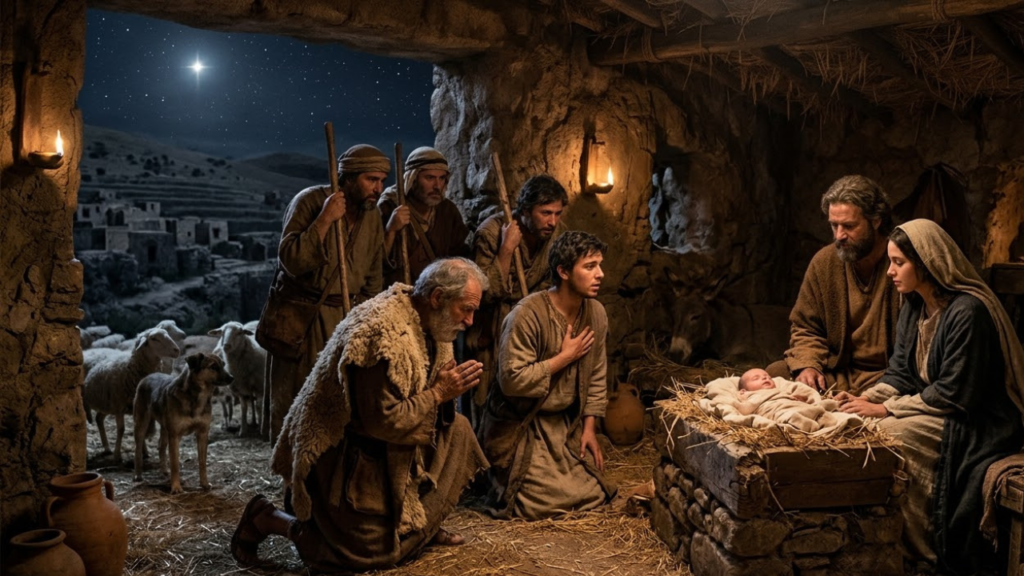
“And it came to pass, as the angels were gone away from them into heaven, the shepherds said one to another, Let us now go even unto Bethlehem, and see this thing which is come to pass, which the Lord hath made known unto us. And they came with haste, and found Mary, and Joseph, and the babe lying in a manger.”
Luke 2:19-20
“But Mary kept all these things, and pondered them in her heart. And the shepherds returned, glorifying and praising God for all the things that they had heard and seen, as it was told unto them.”
Two responses sit side by side. The shepherds went out loud and praising. Mary stayed quiet and pondered. Scripture honors both.
Simeon and Anna at the Temple (KJV)
Forty days after the birth, Mary and Joseph brought Jesus to the temple in Jerusalem (Luke 2:22). Two elderly believers were waiting there.
Luke 2:25
“And, behold, there was a man in Jerusalem, whose name was Simeon; and the same man was just and devout, waiting for the consolation of Israel: and the Holy Ghost was upon him.”
Luke 2:29-32
“Lord, now lettest thou thy servant depart in peace, according to thy word: For mine eyes have seen thy salvation, Which thou hast prepared before the face of all people; A light to lighten the Gentiles, and the glory of thy people Israel.”
Simeon had been promised he would not die before seeing the Lord’s Christ (Luke 2:26). Holding a baby in his arms, he said he was ready to go.
Luke 2:38
“And she coming in that instant gave thanks likewise unto the Lord, and spake of him to all them that looked for redemption in Jerusalem.”
Anna was a widow of great age who “departed not from the temple” (Luke 2:37). She became one of the first people to tell others about Jesus.
The Wise Men and the Star (KJV)
Matthew alone records the visit of the wise men, and his account carries a darker thread — a king who felt threatened.
Matthew 2:1-2
“Now when Jesus was born in Bethlehem of Judaea in the days of Herod the king, behold, there came wise men from the east to Jerusalem, Saying, Where is he that is born King of the Jews? for we have seen his star in the east, and are come to worship him.”
Matthew 2:3
“When Herod the king had heard these things, he was troubled, and all Jerusalem with him.”
Matthew 2:10-11
“When they saw the star, they rejoiced with exceeding great joy. And when they were come into the house, they saw the young child with Mary his mother, and fell down, and worshipped him: and when they had opened their treasures, they presented unto him gifts; gold, and frankincense, and myrrh.”
Read the wording closely: a house, not a stable, and a young child, not a babe. The wise men most likely arrived some time after the birth. Matthew also never says there were three of them — only that there were three kinds of gifts.
Matthew 2:13-15
“And when they were departed, behold, the angel of the Lord appeareth to Joseph in a dream, saying, Arise, and take the young child and his mother, and flee into Egypt, and be thou there until I bring thee word: for Herod will seek the young child to destroy him. When he arose, he took the young child and his mother by night, and departed into Egypt: And was there until the death of Herod: that it might be fulfilled which was spoken of the Lord by the prophet, saying, Out of Egypt have I called my son.”
Who Heard the News First? Every Witness to the Birth of Jesus
One helpful way to study the nativity is to ask a simple question: who found out, how did they find out, and what did they do next? The people below are listed roughly in the order the Gospels introduce them. (Scripture does not say exactly whether Joseph or Elisabeth learned first, so their order is approximate.)
| Witness | How they heard | Key KJV verse | Their response |
| Mary | The angel Gabriel, in Nazareth | Luke 1:31 | Asked how, then surrendered: “be it unto me according to thy word” (Luke 1:38) |
| Elisabeth | Filled with the Holy Ghost when Mary arrived | Luke 1:41-43 | Blessed Mary and called the unborn Child “my Lord” |
| Joseph | An angel in a dream | Matthew 1:20-21 | Woke up and obeyed without a recorded word (Matthew 1:24) |
| Zacharias | Filled with the Holy Ghost after John’s birth | Luke 1:68-69 | Prophesied that God had “raised up an horn of salvation” in David’s house |
| The shepherds | An angel and a heavenly host, at night | Luke 2:10-11 | Went “with haste,” then spread the news and praised God (Luke 2:16-20) |
| Simeon | Promised by the Holy Ghost, led to the temple | Luke 2:26-28 | Held the Child and blessed God, ready to “depart in peace” |
| Anna | Present in the temple at the same hour | Luke 2:38 | Gave thanks and told everyone who looked for redemption |
| The wise men | A star seen in the east | Matthew 2:2 | Traveled, rejoiced, worshipped, and gave gifts (Matthew 2:10-11) |
| Herod | Reports from the wise men | Matthew 2:3 | Was troubled, and later tried to destroy the Child (Matthew 2:16) |
Notice the pattern. The ones who received the news with humility — a young woman, a working man, shepherds, two elderly people at the temple — all responded with worship or obedience. The one person in power felt threatened. The same good news produced opposite reactions, and it still does.
What the Birth of Jesus Means: New Testament Verses (KJV)
Mark begins with Jesus as a grown man, and John never describes the manger at all. Instead, John — along with Paul — explains why the birth happened. These verses are the theology behind the Christmas story.
John 1:1, 14
“In the beginning was the Word, and the Word was with God, and the Word was God… And the Word was made flesh, and dwelt among us, (and we beheld his glory, the glory as of the only begotten of the Father,) full of grace and truth.”
This is John’s nativity account. No shepherds, no star — just the staggering claim that the eternal Word became a human being.
Galatians 4:4-5
“But when the fulness of the time was come, God sent forth his Son, made of a woman, made under the law, To redeem them that were under the law, that we might receive the adoption of sons.”
The birth was not random timing. Paul says it came at “the fulness of the time,” and its purpose was redemption.
Philippians 2:7
“But made himself of no reputation, and took upon him the form of a servant, and was made in the likeness of men:”
1 Timothy 1:15
“This is a faithful saying, and worthy of all acceptation, that Christ Jesus came into the world to save sinners; of whom I am chief.”
1 Timothy 3:16
“And without controversy great is the mystery of godliness: God was manifest in the flesh, justified in the Spirit, seen of angels, preached unto the Gentiles, believed on in the world, received up into glory.”
John 3:16
“For God so loved the world, that he gave his only begotten Son, that whosoever believeth in him should not perish, but have everlasting life.”
The manger and the cross belong to one story. The Child was born so that He could give His life.
2 Corinthians 9:15
“Thanks be unto God for his unspeakable gift.”
Paul wrote this line about generosity, but countless churches read it at Christmas for good reason. Some gifts are too great for words.
A Christmas Eve Read-Aloud Order (KJV)
Many families read the Christmas story aloud on Christmas Eve, but jumping between Matthew and Luke can get confusing. This order weaves the two Gospels together so the story flows from promise to Bethlehem in about 20 minutes. It also works well for a Sunday school class or a candlelight service, with a different reader for each part.
- The promise — Isaiah 9:2, 6-7
- The angel visits Mary — Luke 1:26-38
- Joseph’s dream — Matthew 1:18-25
- The journey to Bethlehem and the birth — Luke 2:1-7
- The shepherds and the angels — Luke 2:8-20
- Simeon in the temple — Luke 2:25-32
- The wise men — Matthew 2:1-12
- Why He came — John 1:14 and John 3:16
A few practical suggestions:
- Let a child read Luke 2:10-11. It is short, easy to pronounce, and it is the heart of the message.
- Pause after Luke 2:19 and give everyone a quiet moment, the way Mary “pondered” these things.
- If time is short, read only steps 4, 5, and 8.
FQA Bible Verses About the Birth of Jesus
Where is the birth of Jesus in the Bible (KJV)?
The birth of Jesus is recorded in two Gospels: Matthew 1:18 through 2:23, and Luke 1:26 through 2:40. Luke 2:1-20 is the best-known passage and is often called “the Christmas story.” John 1:1-14 describes the same event in theological terms rather than as a narrative.
What is the main Bible verse about the birth of Jesus?
Luke 2:11 is the verse most often quoted: “For unto you is born this day in the city of David a Saviour, which is Christ the Lord.” Isaiah 9:6 is the most-quoted prophecy of His birth.
Does the Bible say Jesus was born on December 25?
No. Scripture does not give a date for the birth of Jesus. Christians have celebrated it on December 25 for many centuries, but the Bible itself is silent on the day and the month.
Were the wise men at the manger?
The KJV wording suggests they came later. Matthew 2:11 says they came “into the house” and saw “the young child,” while the shepherds in Luke 2:16 found “the babe lying in a manger.” Herod’s order to kill boys “from two years old and under” (Matthew 2:16) also suggests some time had passed.
Why do Matthew and Luke tell different parts of the story?
Each writer selected details for his own readers. Matthew, writing with Jewish readers in mind, focuses on Joseph, King David’s line, and fulfilled prophecy. Luke, who says he “had perfect understanding of all things from the very first” (Luke 1:3), focuses on Mary, the shepherds, and the people waiting in the temple. The two accounts complete each other rather than compete.
A Short Prayer Based on the Nativity Verses
This prayer draws its words from the passages above and can be read at the close of a family reading or a Christmas service.
Heavenly Father,

Thank You for keeping Your word. What You promised through Isaiah and Micah, You fulfilled in Bethlehem. Thank You for sending Your Son, born of a virgin, laid in a manger, and named Jesus because He came to save His people from their sins. Give us the humble faith of the shepherds, the quiet heart of Mary, and the ready obedience of Joseph. Like Simeon, let our eyes see Your salvation, and like Anna, let us speak of Him to everyone who is waiting for hope. Thanks be unto God for His unspeakable gift.

In the name of Jesus Christ, Amen.
Closing Thoughts
The birth of Jesus was announced to a handful of people: a young woman in Nazareth, a carpenter asleep, shepherds in a field, two faithful worshippers in the temple, and travelers who followed a star. None of them were looking for a stable. All of them found the Saviour.
The KJV verses in this collection can be read in a single sitting, but they are worth returning to slowly through the Christmas season. Start with Luke 2, keep Isaiah 9:6 close by, and end where John does — with the Word made flesh, full of grace and truth.
All Scripture quotations are from the King James Version (KJV), which is in the public domain outside the United Kingdom.

Role: Founder & Spiritual Writer at TheGodMessage.com
About: Himanshu is a Jesus-centered writer known for creating clear, uplifting, and Bible-rooted content for modern believers.
Expertise: specializes in prayers, devotionals, and spiritual guidance designed to help readers grow stronger in faith no matter where they are in life.
Purpose: His mission is to inspire readers to connect with their inner self, experience peace, and understand the messages of the universe. “My mission is simple, to bring God’s light into your everyday life.”